
How Much Does a Sled Weigh? (Average Weight by Type & Size)
Key Takeaways
Sleds come in many forms, from snow play to competitive racing to gym training. Their weight affects speed, control, and usability. Knowing how much does a sled weigh helps you choose the right one for your goal. A lighter sled moves faster and is easier to handle. A heavier sled adds stability and can carry more load.
On average, most sleds weigh between 5 and 460 pounds, depending on type, material and design. As many people have different perceptions of what a Hyrox sled actually weighs or feels like in the gym. Some think the sled itself is light, while others say it feels heavier depending on the surface or the setup.

As seen in the picture above, even experienced one’s report variations between gym sleds and official Hyrox setups. This article is written to clear up that confusion and give you a data-backed view of the real Hyrox sled weight, how it compares across gyms, and what actually affects resistance.

Average Sled Weight by Type
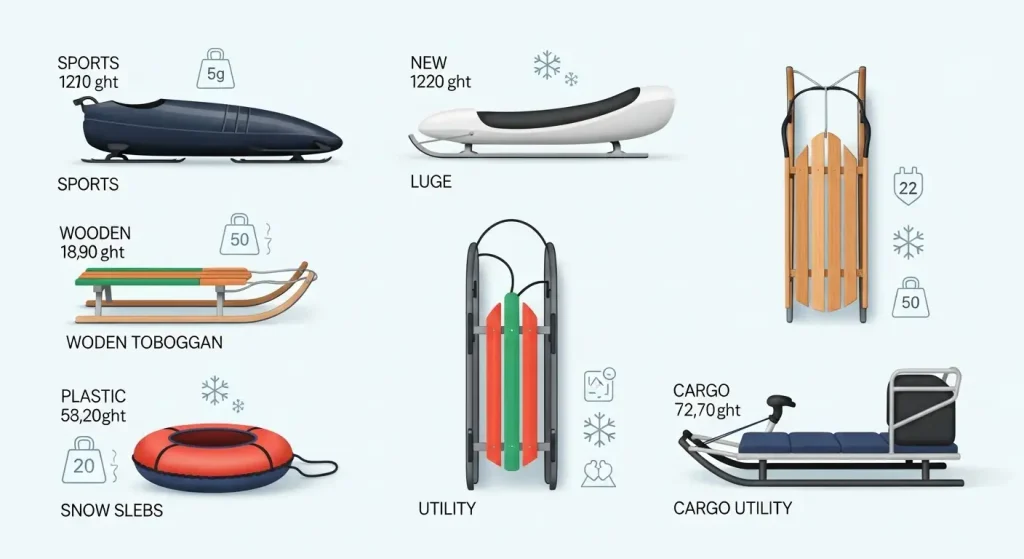
Here is the table to demonstrate average sled weigh by type;
| Sled Type | Average Weight | Main Use | Material |
|---|---|---|---|
| Plastic sled | 2–10 lb | Kids, recreation | HDPE plastic |
| Snow tube | 5–12 lb | Family fun | PVC or rubber |
| Wood sled | 10–25 lb | Adults, classic design | Maple, ash, steel runners |
| Racing sled | 20–460 lb | Luge, skeleton, bobsled | Carbon fiber, steel |
| Cargo sled | 20–100+ lb | Hunting, hauling gear | Polyethylene |
A lightweight plastic sled is perfect for quick fun. A wood or cargo sled is better for durability and load capacity. Racing sleds are highly specialized, built for precision and speed.
Gym and Training Sleds
Not all sleds slide on snow. In gyms, sleds are used for pushing, pulling, and resistance workouts. These are built from steel, with high load capacities. Some are them are as follows;
A loaded Hyrox sled can weigh close to 300 to 350 pounds. To visualize that weight, check our comparison in Things That Weigh 300 Pounds.
Resistance also changes with flooring type. Turf, carpet, or rubber surfaces each affect drag differently, making training intensity adjustable. These sleds build power and endurance for sprint and functional athletes.
Fact…
Studies on resisted sled training show that sled loads between 20–80% of an athlete’s body weight can significantly improve sprint acceleration by 2–5% over short distances (5–20 m). Heavier loads (~75–80% body weight) are especially effective for increasing horizontal force output, while lighter loads (~20–30%) enhance speed and sprint mechanics.
For comparison with other gym tools, see How Much Does an EZ Bar Weigh, where we break down barbell weights used in similar training environments.
Factors That Affect Sled Weight
These are the factors that are invloved in the weight of sled gym.
- Material: The number one factor is material as the Plastic is light. Wood and steel add mass but improve stability. Carbon fiber combines low weight with high strength.
- Size and capacity: One-person sleds are under 10 pounds. Multi-person or cargo models weigh 20 pounds or more.
- Purpose: Recreational sleds are built for ease of use. Racing and gym sleds are designed for performance and resistance.
- Accessories: Runners, brakes, or handles can add several pounds.
- The above are major factor affecting in weighs of a sled.

Sled Weight and Performance
Sled weight shapes how it performs on any surface. A few extra pounds can change speed, control, and effort required.
- Light sleds move faster and are easier to lift or steer. They work well on smooth, packed snow or short gym sprints but they can lose control on steep or icy slopes.
- Medium-weight sleds balance control and mobility. They handle mixed conditions and can carry moderate loads without slowing too much.
- Heavy sleds stay grounded and track straighter. They are ideal for hauling, racing, or power training but need more force to move.
In bobsled and skeleton racing, sled weight directly affects start speed and cornering. Heavier sleds gain momentum faster downhill but require precise control. That’s why the International Bobsleigh and Skeleton Federation (IBSF) sets strict weight limits:
- Two-man sleds: up to 390 kg (860 lb) including crew.
- Four-man sleds: up to 630 kg (1,388 lb) including crew.
In gym workout sleds, added plates or friction simulate resistance rather than gravity. A heavier load builds strength and endurance, while lighter resistance improves speed and conditioning.
To convert sled weights between pounds and kilograms easily, use our Weight Conversion Tool.
How to Choose the Right Weight (Sled)
Choosing the right sled weight depends on your purpose, body strength, and surface conditions. The right choice improves performance, safety, and control.
Recreational Sleds (Plastic or Snow Tubes)

Go for a sled that weighs under 10 pounds. It is very easy to carry uphill and light enough for kids. A plastic sled or snow tube glides better on packed snow because of lower surface friction.
Cargo and Utility Sleds

For hauling gear, hunting equipment, or camping supplies, pick a sled between 20 and 40 pounds. Heavier sleds have stronger frames and higher load capacity. They perform better on deep or uneven snow.
Racing Sleds (Bobsled, Luge, Skeleton)

These sleds are built for speed and control. Weight limits are set by each sport’s federation to maintain fairness and safety. A typical racing sled can weigh from 20 to 460 pounds depending on design and athlete weight. The balance between sled mass and aerodynamics is key for top performance.
Gym Training Sleds (Hyrox, Rogue, Torque, Titan)

Start light to learn proper form. Add resistance gradually by loading weight plates. Heavier sleds increase muscle power, strength endurance, and conditioning. On turf or rubber flooring, surface friction will add natural resistance, even without extra plates.
In short, match the sled weight to your goal: speed for light sleds, stability for medium sleds, and resistance for heavy sleds.
Real-World Examples
Here is a table to examine the real world use cases;
| Model | Type | Empty Weight | Use |
|---|---|---|---|
| Flexible Flyer Snow Screamer | Plastic sled | 6 lb | Kids and family sledding |
| Yukon Charlie’s Hammerhead | Wood sled | 14 lb | Adult recreational sled |
| Pelican Trek 75 | Cargo sled | 25 lb | Gear hauling |
| Hyrox Competition Sled | Gym sled | 66 to 150 lb | Functional fitness |
| Rogue Dog Sled 1.2 | Gym sled | 100 lb | Strength training |
These examples clearly shows that how the sled weigh changes across designs and uses.
How to Train for the Hyrox Sled Push and Pull
To perform well in the Hyrox sled events, you need to train both strength and technique. The sled push and sled pull combine lower-body power, grip strength, and aerobic endurance. The goal is to recreate race conditions as closely as possible.
Set up your sled on a surface similar to Hyrox turf. Use a load that challenges you but still allows good form. For beginners, start with 60 to 70 percent of the official Hyrox sled weight and progress as your fitness improves.
Include compound lifts like squats, lunges, and deadlifts to build leg power. Add sled drags, rope pulls, and short sprint intervals to increase endurance and control. Keep your pushing angle low, maintain short steps, and focus on steady breathing.

To track how far you push or pull the sled each session, use a measurement calculator to convert distances between meters, feet, or yards. This helps you log accurate training data, especially if your gym marks distances differently. Consistent tracking makes it easier to monitor progress and replicate event conditions.
Fact…
According to Healthline, pushing a sled loaded with 25–70% of your maximum load can significantly improve speed, power, and endurance, with studies showing athletes who trained twice weekly for 8 weeks increased sprint performance by up to 5% when using heavier resistance.
The Bottom Line
The weight of a sled can vary more than most people think. Hyrox sleds, Rogue sleds, and other gym models all differ based on design, surface friction, and load setup. Knowing the base weight helps, but the real test comes from how it feels during movement.
If you train for Hyrox or functional workouts, focus on matching resistance rather than chasing a single number. Track your load, distance, and surface conditions to stay consistent.
Understanding how gym sleds work under different setups gives you a clear edge. It turns guesswork into strategy and helps you perform with precision when it counts.
Frequently Asked Questions (Gym Sled Weigh)
Does sled push build calves?
Yes, sled pushes can build your calves. When you drive each step during a sled push, your foot pushes off through the ball and toes, forcing your calves to contract and stabilize the ankle-foot complex. Because you’re pushing against resistance while leaning forward and taking rapid, short steps, the calves must generate force and endure repeated activation. Over time this increases calf strength and muscular endurance.
Is sled push better than running?

Offcourse, sled pushes are better for strength and power, while running is better for endurance and heart health. Combining both provides the most balanced fitness benefits. As sled pushes build strength, power, and acceleration, engaging the quadriceps, glutes, calves, and core while offering a low-impact alternative that reduces stress on joints. They’re ideal for improving explosive speed, muscle endurance, and conditioning in short bursts. On the other hand, running is better for developing cardiovascular endurance, stamina, and aerobic capacity over longer distances.
How much does a luge sled weigh?
A singles luge sled weighs between 21 and 25 kg (46–55 lbs), while a doubles sled is slightly heavier, ranging from 25 to 30 kg (55–66 lbs). These weight limits are strictly regulated by the International Luge Federation to ensure every race is a fair test of skill.
How much does the hyrox empty sled weight?
The Hyrox empty sled (unloaded, without added plates) weighs approximately 30-60 kg for the push configuration (including poles) in recent events, based on athlete reports and calculations from official loaded weights like 152 kg total (e.g., 4 × 25 kg plates plus a small 2 kg cap plate). For the pull (no poles attached), it’s often estimated around 25 kg. Official Hyrox sources list only the total competition weights (including sled), which vary by division—e.g., 102–202 kg for push and 78–153 kg for pull—but do not publicly specify the exact empty sled weight. In practice, the unloaded figure ranges 30–52 kg depending on the specific model (often Centr-branded in newer events), surface friction, and setup, making exact replication in training more about feel and total load than precise empty weight alone.
How much does a rogue sled weigh?
The Rogue Echo Dog Sled, one of the most popular training sleds from Rogue Fitness, weighs 87-100 pounds when unloaded, featuring a durable single-piece 1/4-inch steel base designed for heavy-duty pushing, pulling, and dragging workouts. This weight excludes any additional Olympic plates added to the center post for resistance, allowing users to scale intensity from light conditioning sessions to maximal strength efforts with capacities exceeding 450 pounds.