
Lumber Weight Calculator – Estimate Any Board’s Weight Instantly
Use this Wood Weight Calculator to estimate how much a piece of wood weighs before you lift, move, ship, or price it.
It works for common lumber, hardwoods, softwoods, plywood, and logs.
Calculate the Lumber Weight
Estimate the weight of wood instantly
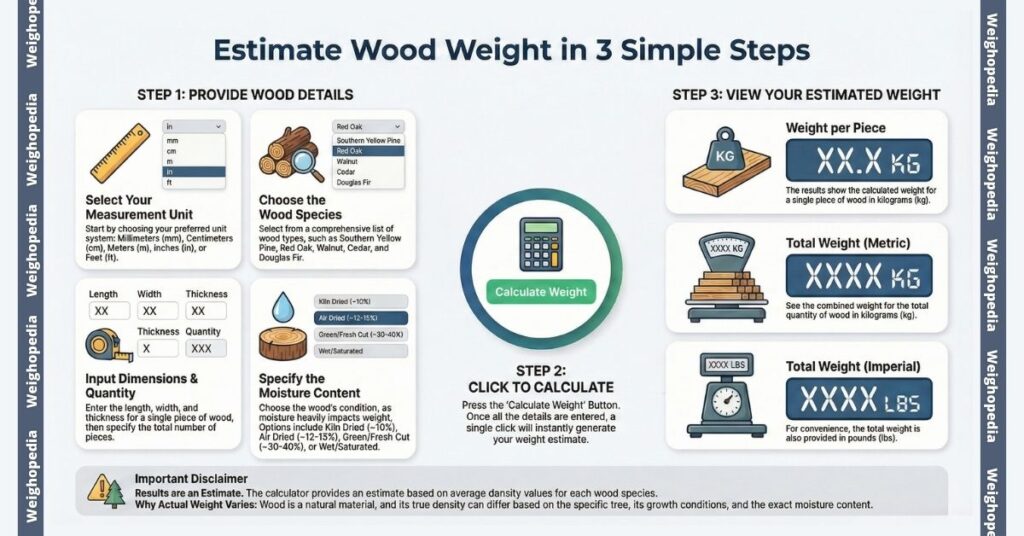
Disclaimer: This is an estimate based on average species density. Wood is a natural material and actual density varies by tree, growth conditions, and exact moisture content.
INPUTS
- Wood Type: (Select from list: e.g., Southern Yellow Pine, Douglas Fir, Red Oak, Hard Maple, Walnut, Cedar, Plywood, MDF).
- Dimensions:
- Thickness (inches or cm)
- Width (inches or cm)
- Length (foot or meters)
- Quantity: Number of boards/logs.
- Moisture Condition: Air Dry (Standard 12%) or Green (Freshly cut 30% to 40%).
OUTPUTS
- Estimated weight per piece in Kilogram (kg)
- Estimated Total weight in kilograms (kg)
- Estimated Total weight in Pounds (lbs)
- Disclaimer: Wood is a natural material with varying density based on growth rings and moisture content. These results are estimates based on average specific gravity values for air-dried lumber (approx. 12% moisture content) unless “Green” is selected.
The weight of lumber depends on its volume and density.
Under standard conditions, 1 cubic foot of kiln-dried softwood weighs ~25–35 lb (11–16 kg), while kiln-dried hardwood weighs ~35–50 lbs (16–23 kg).
Green (fresh) wood can weigh 30–60% more due to retained moisture.
How the Calculator Works (Trust Layer)
This timber weight calculator follows a simple, reliable logic:
What affects the result?
What doesn’t affect the results?
What Can Change the Result
Even with accurate measurements, several factors can significantly alter the actual weight of your lumber.
|
Moisture Content Wood holds water in its cells. Green lumber can weigh significantly more than kiln-dried lumber of the same size. |
Engineered vs Solid Wood Plywood, MDF, and particleboard often weigh more than softwood lumber because of adhesives and compressed fibers. |
|
Wood Species Dense species (like oak or maple) weigh more per cubic foot than lighter species (like pine or cedar). |
Actual Dimensions vs Nominal Size A “2×4” does not measure 2 inches by 4 inches. Planed lumber is smaller, which reduces actual weight. |
Did You Know? According to global lumber production estimates (2022–2023), worldwide lumber output reached about 481.3 million cubic meters, while total roundwood removals are close to 4 billion cubic meters annually. The market is highly concentrated, with the USA, China, and Russia producing 45.7%, and the top 10 countries accounting for over 77% of global lumber production. (FAO)
Practical Real-World Use Cases
|
1. Lifting and Safety Planning |
|
If a hardwood lumber slab weighs 120 lb (54 kg), one person should not lift it alone. Knowing the weight helps prevent injuries. |
|
2. Transport and Shipping |
|
A stack of 20 kiln-dried 2×4 boards (8 ft long) weighs roughly 260–300 lb (118–136 kg). This matters for vehicle load limits and shipping costs. |
|
3. Storage and Shelving |
|
Shelving rated for 200 lb may fail if loaded with dense hardwood boards. Weight estimates help avoid structural damage. |

Quick Reference of Wood Weight
All values assume 1 cubic foot of wood. Actual weight varies by moisture and milling.
Softwoods
| Wood Type | Kiln-Dried | Air-Dried | Green |
|---|---|---|---|
| Pine (average) | 28 lb (13 kg) | 34 lb (15 kg) | 45 lb (20 kg) |
| Fir | 29 lb (13 kg) | 35 lb (16 kg) | 48 lb (22 kg) |
| Spruce | 26 lb (12 kg) | 32 lb (15 kg) | 44 lb (20 kg) |
| Cedar | 23 lb (10 kg) | 28 lb (13 kg) | 38 lb (17 kg) |
Hardwoods
| Wood Type | Kiln-Dried | Air-Dried | Green |
|---|---|---|---|
| Oak (red/white avg.) | 44 lb (20 kg) | 52 lb (24 kg) | 63 lb (29 kg) |
| Maple | 44 lb (20 kg) | 51 lb (23 kg) | 60 lb (27 kg) |
| Birch | 43 lb (19 kg) | 50 lb (23 kg) | 61 lb (28 kg) |
| Walnut | 38 lb (17 kg) | 45 lb (20 kg) | 55 lb (25 kg) |
| Beech | 45 lb (20 kg) | 53 lb (24 kg) | 65 lb (29 kg) |
Engineered & Sheet Goods
| Material | Approx. Weight per Cubic Foot |
|---|---|
| Plywood (construction grade) | 40–45 lb (18–20 kg) |
| OSB | 42–48 lb (19–22 kg) |
| MDF | 45–55 lb (20–25 kg) |
| Particleboard | 40–50 lb (18–23 kg) |
Quick Board-Level Reference (Kiln-Dried)
| Common Board | Approx. Weight |
|---|---|
| 2×4 × 8 ft (softwood) | 13–15 lb (6–7 kg) |
| 2×6 × 8 ft (softwood) | 20–22 lb (9–10 kg) |
| 4×4 × 8 ft (softwood) | 30–35 lb (14–16 kg) |
| Hardwood plank (1″ × 6″ × 8 ft) | 12–15 lb (5–7 kg) |
Manual Calculations
You can estimate wood weight manually:
- Measure the board’s length, width, and thickness.
- Convert dimensions to cubic feet.
- Multiply volume by average density:
- Softwood (dry): approx 30 lb per cubic foot
- Hardwood (dry): approx 45 lb per cubic foot
- Adjust upward if the wood is air-dried or green.
Assumption: average density and uniform moisture
If you need to calculate wood weight precisely without a tool, follow these steps.
Formula:
Step-by-Step Example:
Myth VS Fact
MYTH
FACTS
Frequently Asked Questions (FAQs)
How much does a 2×4 weigh?
An 8-ft kiln-dried softwood 2×4 weighs about 13–15 lb (6–7 kg).
How much does a sheet of plywood weigh?
A standard 4×8 foot sheet of 3/4-inch softwood plywood weighs approximately 60 to 70 lbs (27-31 kg). MDF is heavier, weighing roughly 90 lbs for the same size.
What is the heaviest common wood?
Among common domestic woods, Live Oak and Hickory are the heaviest, weighing roughly 50-60 lbs per cubic foot. Exotic woods like Lignum Vitae or Ebony are significantly heavier and can sink in water.
Does staining or painting wood add significant weight?
No. Finishes are applied in thin layers. While they add a negligible amount of mass, they do not significantly impact the structural load or shipping weight of a project.
Bottom Line
Wood weight is not guesswork; it’s a function of volume, density, and moisture.
Using a lumber calculator before lifting, transporting, or pricing wood helps you make safer, more accurate decisions and avoid costly mistakes.
If you think this article helps you, check out the measurement calculator to know the exact measurements of your wood.