
How Much Does a Yard of Dirt Weigh?
A cubic yard of dry, loose dirt generally weighs between 2000 and 2200 pounds (900 to 1000 kg) perhaps 2100 pounds. This equals roughly one US short ton. However, weight changes drastically based on composition and weather.
Heavy wet soil can spike to 3000 pounds (1360 kg) per yard, while fluffy topsoil rich in compost might weigh as little as 1600 pounds (725 kg).
Before digging into it, first we need to understand what 1 cubic yard of dirt looks like, you first need to know what a cubic yard actually is.

How Big is a Cubic Yard?
A cubic yard is a space that measures 3 feet long, 3 feet wide, and 3 feet high, for a total of 27 cubic feet.
What Does 1 Cubic Yard Look Like?
Think of a perfect cube where each side is 3 feet. That is the size of one cubic yard.
To visualize it better:
- About the size of a standard washing machine.
- Similar to a large moving box stack.
- Roughly fills the bed of a small pickup truck (level load).
| Dimension | Measurement |
|---|---|
| Length | 3 feet |
| Width | 3 feet |
| Height | 3 feet |
| Total volume | 27 cubic feet |
If you spread 1 cubic yard of dirt, it can cover:
- 100 square feet at 3 inches deep.
- 80 square feet at 4 inches deep.
This helps when planning gardening, landscaping, or filling projects.
Converting Cubic Yards to Other Units
One cubic yard equals 27 cubic feet or about 0.76 cubic meters.
Breakdown
- 1 cubic yard = 27 cubic feet
- 1 cubic yard = 0.7646 cubic meters
These conversions help you estimate volume when switching between US and metric systems or when comparing soil, gravel, or mulch quantities.
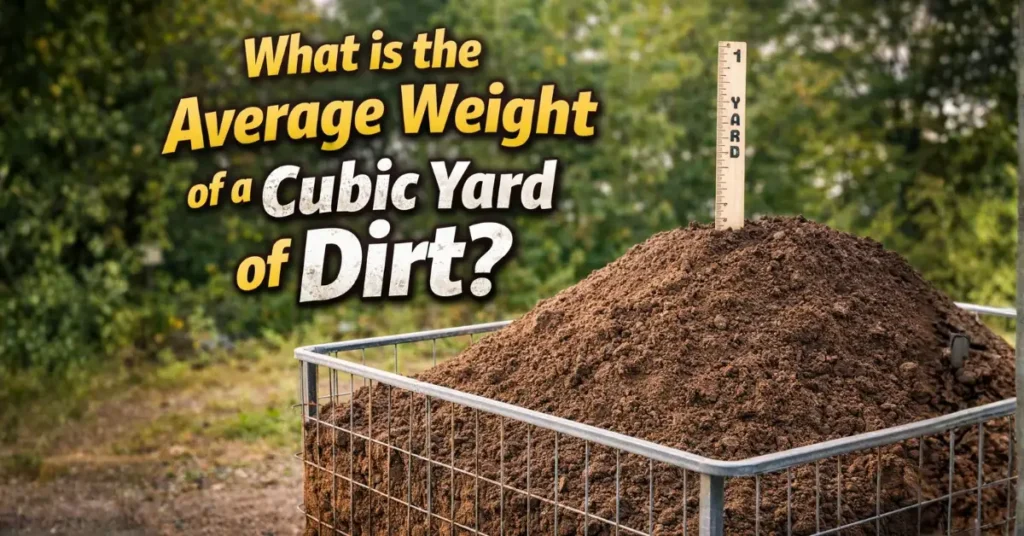
What is the Average Weight of a Cubic Yard of Dirt?
If you are planning a landscaping project, you might think how big is a cubic yard of dirt weigh just because, you usually calculate your needs in cubic yards. But your truck cares about pounds.
For most general purposes, you should estimate that 1 cubic yard of standard soil weighs about 2100 pounds (950 kg). This figure is a safe baseline for dry, loose earth typically sold as “loam” or garden soil.
According to Caterpillar, a global leader in construction equipment, provide specific data showing how much this number can fluctuate. According to their material density tests, “Earth, Loam” weighs 2100 pounds per loose cubic yard, while stripped “Topsoil” can be lighter at roughly 1600 pounds (725 kg) because it contains more air and organic material.
Conversely, government waste conversion tables from Public Works Los Angeles County, list dry soil at 2025 pounds (918 kg).
If you plan to haul dirt in your own vehicle, plan for a load of at least one ton (2000 lbs) per cubic yard to stay on the safe side.
How much does a Cubic Yard of Topsoil Weigh?
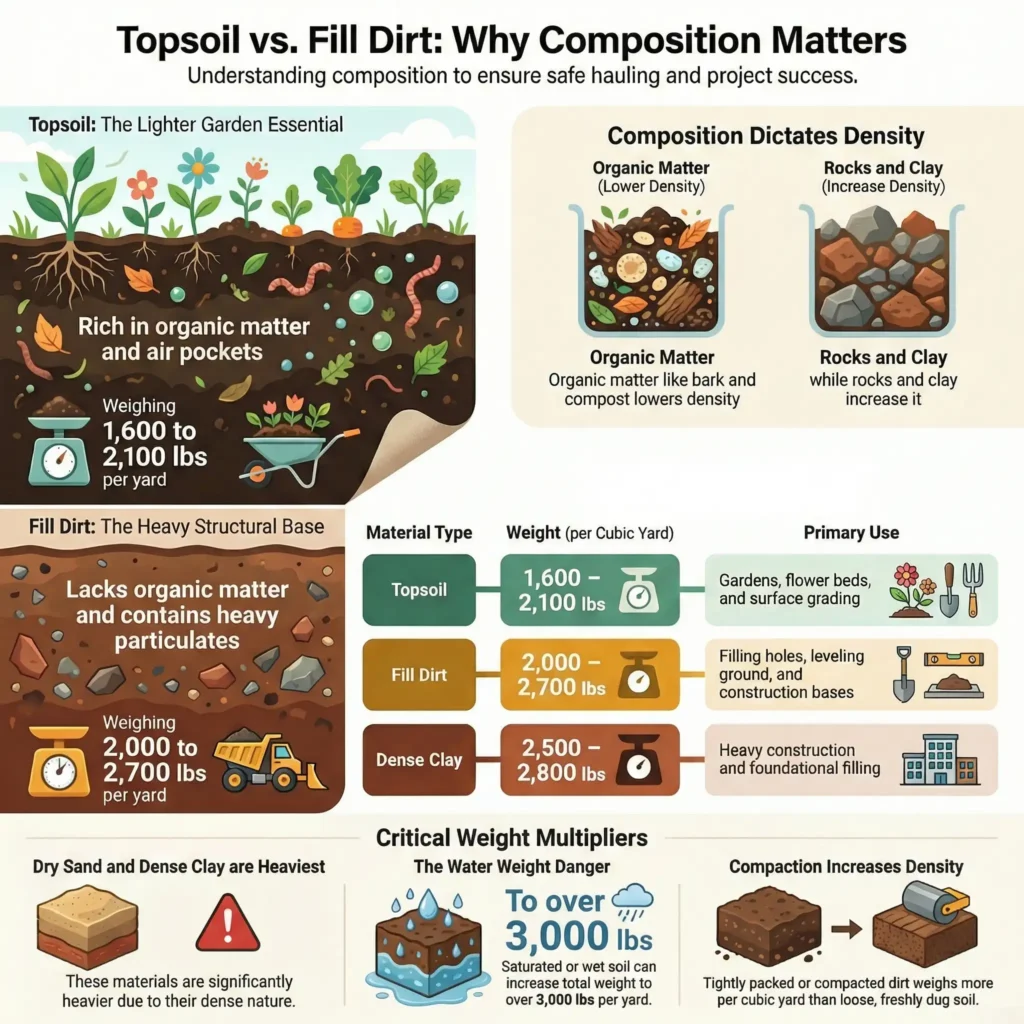
1 cubic yard of topsoil typically weighs 1600 to 2100 pounds (725 to 950 kg). When the soil is wet or fully saturated, the weight can increase to 3000 pounds (1360 kg) or more. Topsoil is most commonly sold in 40-pound bags, and each bag contains about 1 cubic foot. This makes bag counting the easiest way to estimate volume for small projects. (The Spruce)
The weight of topsoil depends on soil composition, organic matter, and moisture content. Dry, loose topsoil is much lighter. Moist or water-saturated soil becomes significantly heavier.
In most landscaping projects, garden soil weighs nearly the same as topsoil, typically 1600 to 2100 pounds per cubic yard, depending on moisture level, compost content and soil mix.
Cubic Yard of Topsoil Weight Chart
| Topsoil condition | Weight (lbs) | Weight (kg) |
|---|---|---|
| Dry, loose topsoil | 1600 – 1800 | 725 – 815 |
| Average garden topsoil | 1800 – 2100 | 815 – 950 |
| Moist topsoil | 2100 – 2700 | 950 – 1225 |
| Fully saturated, wet soil | 3000+ | 1360+ |
Why does Topsoil Weight vary so much?
Topsoil contains organic matter that reduces density. When soil absorbs water, its pore spaces fill with moisture. This adds significant mass. Rainfall can easily increase the weight of 1 cubic yard of soil by 30 to 50 percent.
If you order 5 cubic yards of dry topsoil, the total weight will be around 8000 to 10500 pounds. If the same soil is wet, the load can exceed 15000 pounds. Always check your truck capacity and axle limits before transport.
Topsoil vs. Fill Dirt: Why Composition Matters
Not all dirt is created equal. The specific ingredients in your soil mix will dictate how heavy the load is.
Topsoil is the upper layer of earth. It typically includes organic matter like leaves, bark, and compost. These ingredients create air pockets and lower the overall density.
Fill dirt is the stuff beneath the topsoil. It usually lacks organic matter and contains heavy particulates like rocks, sand, and clay. Because it compacts easily, it is much denser.
If your local dirt has high clay or sand content, it will be significantly heavier. Loose dry sand weighs around 2400 pounds (1090 kg) per yard, while dense clay can weigh as much as 2500 to 2800 lbs (1130 – 1270 kg)
The Impact of Moisture: Dry vs. Wet Soil
Water is the single biggest variable in soil weight. Soil acts like a sponge. When it rains, the volume of the dirt stays the same, but the weight shoots up.
Experts estimate that a cubic yard of saturated, wet topsoil can weigh 3000 pounds (1360 kg) or more. That is a 50% increase over the dry weight. (WikiHow)
Real-World Example: A homeowner ordered ten 50 pound bags of concrete mix for a small patio project. The delivery arrived after a night of heavy rain. The torn packaging let moisture seep in.
Each bag absorbed water and gained extra weight. What should have been a 50 pound load felt closer to 65 pounds. Carrying the bags from the driveway to the backyard took twice the time. A standard wheelbarrow could handle only one bag at a time due to the added mass.
If you are buying bulk soil, try to schedule delivery or pickup during a dry spell. If it rained the night before, your “one ton” load could easily turn into a 3000 pound or even two tons.
Material Density
Use these charts to estimate the weight for your specific project. These numbers apply to loose material (excavated and not compacted).
Weight by Material Type:
| Material Type | Weight per Cubic Yard (lbs) | Weight per Cubic Yard (kg) |
|---|---|---|
| Topsoil (Loose) | 1600 – 2100 lbs | 725 – 950 kg |
| Fill Dirt (Dry) | 2000 – 2200 lbs | 900 – 1000 kg |
| Sand (Dry) | 2400 lbs | 1090 kg |
| Clay (Dry) | 2500 lbs | 1135 kg |
| Wet/Saturated Soil | 3000+ lbs | 1360+ kg |
| Compost | 1250 lbs | 565 kg |
| Mulch/Wood Chips | 1000 lbs | 450 kg |
Volume Conversions:
| Volume | Estimated Weight (Topsoil) | Equivalent Unit |
|---|---|---|
| 1 Cubic Yard | 2100 lbs (950 kg) | 1 Pickup Truck Load |
| 0.5 Cubic Yard | 1050 lbs (475 kg) | 1 Small Trailer Load |
| 1 Cubic Foot | 75 – 80 lbs (35 kg) | 2 Large Bags |
| 1 Wheelbarrow | 230 lbs (105 kg) | 3 Cubic Feet |
Can My Pickup Truck Haul a Yard of Dirt?
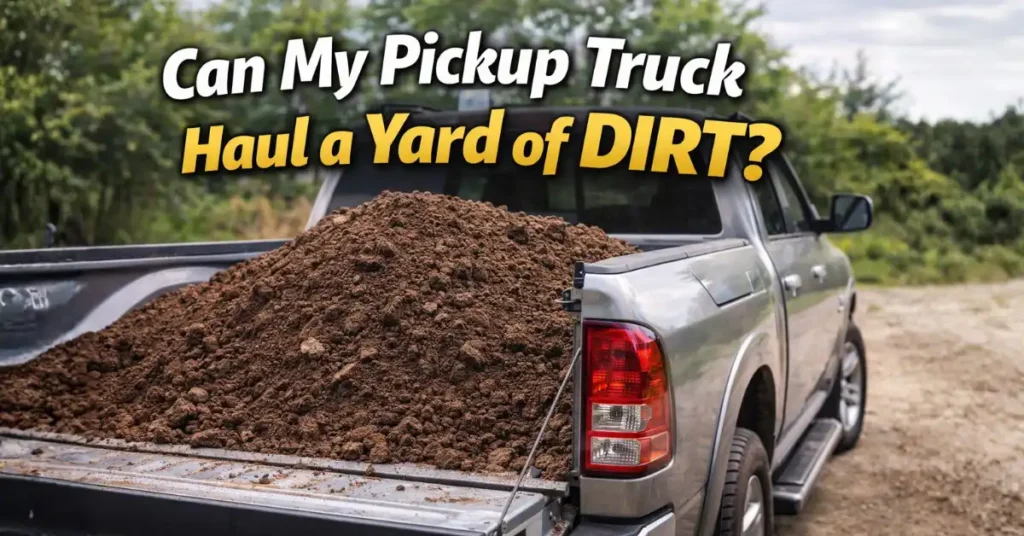
This is the most common question homeowners ask. The answer depends on your specific truck, but you must be careful.
Standard pickup trucks like the Ford F-150, Chevy Silverado 1500, or Ram 1500 are often called “half-ton” trucks. While modern versions have improved, their payload capacity generally ranges from 1500 to 3000 pounds (680 – 1360 kg) depending on the engine and suspension.
Since a yard of dirt weighs about 2100 pounds, a standard pickup can typically carry one cubic yard safely.
The Danger Zone: Do not attempt to haul two cubic yards in a standard pickup. Two yards will weigh over 4000 pounds. This exceeds the payload limit of almost all non-commercial trucks. Overloading causes:
If you need more than one yard, you should either make multiple trips, rent a heavy-duty dump trailer, or pay for delivery. A standard commercial dump truck can carry 10 to 12 cubic yards at once.
Bags vs. Bulk: Which Should You Buy?
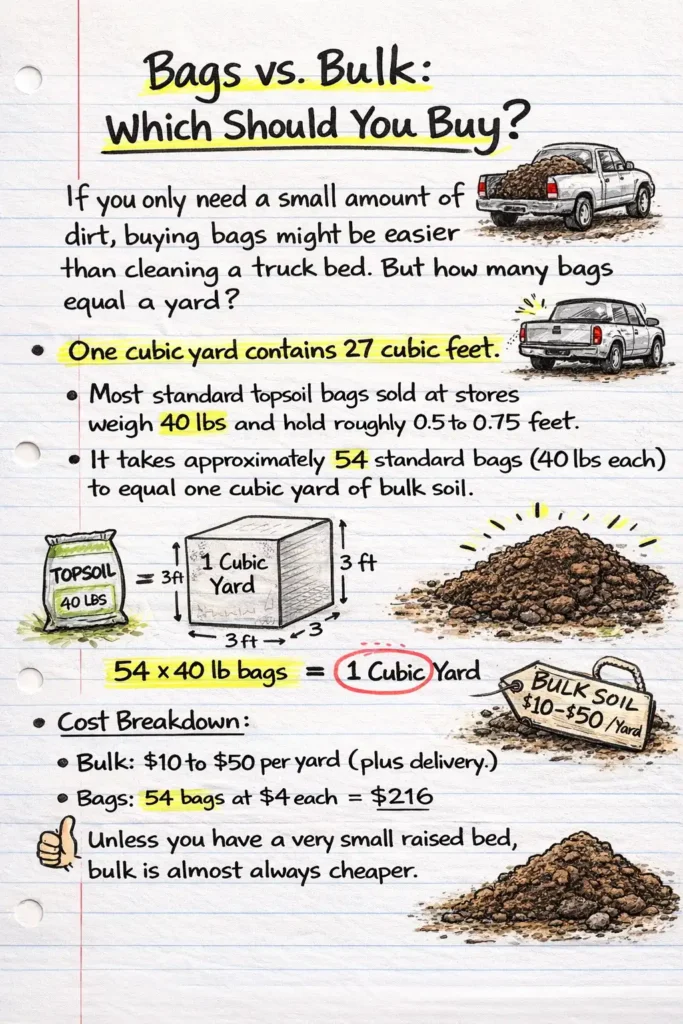
If you only need a small amount of dirt, buying bags might be easier than cleaning a truck bed. But how many bags equal a yard?
One cubic yard contains 27 cubic feet.
- Most standard topsoil bags sold at stores weigh 40 pounds and hold roughly 0.5 to 0.75 cubic feet.
- It takes approximately 54 standard bags (40 lbs each) to equal one cubic yard of bulk soil.
Cost Breakdown:
- Bulk: $10 to $50 per yard (plus delivery).
- Bags: 54 bags at $4 each = $216.
Unless you have a very small raised bed, bulk is almost always cheaper.
How Many Bags of Dirt is 5 Cubic Yards?
Five cubic yards of dirt equal 135 cubic feet, so you will need about 135 standard 1-cubic-foot bags. Because a cubic yard of dirt equals 27 cubic feet, so you will need about 27 standard 1-cubic-foot bags to make one yard.
Bag Breakdown by Size
Different brands sell soil in different bag sizes. Use this table for quick estimates:
| Bag Size | Bags Per 5 Cubic Yard |
|---|---|
| 1 cubic foot bag | 135 bags |
| 0.75 cubic foot bag | 180 bags |
| 0.5 cubic foot bag | 270 bags |
Weight-Based Estimate
If soil is sold by weight, here is a rough guide:
| Bag Weight | Approx. Bags Per 5 Yard |
|---|---|
| 40 lb bags | 200 to 225 bags |
| 50 lb bags | 160 to 180 bags |
The exact number depends on soil type and moisture level. Wet soil weighs more, so fewer bags may be needed to reach the same volume.
Simple Formula:
To estimate bags quickly:
Cubic feet per yard ÷ bag size = total bags needed
Example:
27 ÷ 0.75 = 180 bags
Practical Example:
If you are covering a large garden area or leveling a yard, 5 cubic yards is a common order size. Buying this as individual bags would require over 100 bags, which is labor-intensive. Bulk delivery is usually the better option for projects at this scale.
How to Measure Soil Moisture at Home
Since water weight is risky, you might want to test the soil before hauling it. You do not need a lab for this.
The Squeeze Test: Grab a handful of soil and squeeze it firmly.
- If it crumbles apart immediately, it is dry.
- If it holds its shape in a tight clump or drips water, it is wet. Wet soil will be significantly heavier than the estimates in this article.

For a precise measurement, weigh a small sample of moist soil. Put it in an oven to dry it out completely, then weigh it again. The difference in weight is the water mass. You can calculate the percentage of moisture to see how much extra weight you are carrying
Frequently Asked Questions (FAQs)
1. How many wheelbarrow loads are in a yard of dirt?
It takes about 9 full wheelbarrow loads to move one cubic yard of dirt. This assumes you are using a standard wheelbarrow that holds 3 cubic feet. Be prepared for a workout, as each load will weigh roughly 230 pounds
2. How much does a 2-cubic-foot bag of soil weigh?
A large 2-cubic-foot bag usually weighs between 75 and 80 pounds (35 kg) when dry. If the bag has been sitting in the rain, it can easily exceed 100 pounds. Always lift with your legs!
3. Does compost weigh less than dirt?
Use the formula:
Length x Width x Depth (in feet).
Multiply these three numbers to get cubic feet. Then, divide the result by 27 to get cubic yards.
Example:
A raised bed that is 8 ft long, 4 ft wide, and 1 ft deep = 32 cubic feet. Divided by 27, you need 1.18 cubic yards
4. How do I calculate how much dirt I need?
Slush is very heavy. While fresh snow weighs about 3 to 4 pounds per cubic foot, slush (wet snow) can weigh between 25 and 52 pounds (11 to 23 kg) per cubic foot. This is why slush is so difficult to shovel and dangerous for roofs.
5. Why is “Bank” weight different from “Loose” weight?
Bank dirt refers to soil in its natural state in the ground, where it is compacted and dense. Loose dirt has been dug up and excavated. Digging introduces air into the soil, causing it to swell and take up more space. Therefore, a cubic yard of loose dirt weighs less than a cubic yard of bank dirt
Conclusion
Knowing that a yard of dirt weighs roughly 2100 pounds (or just over 1 ton) is essential for anyone hauling materials. No matter you are filling a raised bed or grading a lawn, always account for the type of soil and the weather.
A rainy day can turn a safe truckload into a dangerous one. When in doubt, make two trips or opt for professional delivery to save your vehicle and your back.