
How Much Does a Cloud Weigh? (The Surprising Answer)
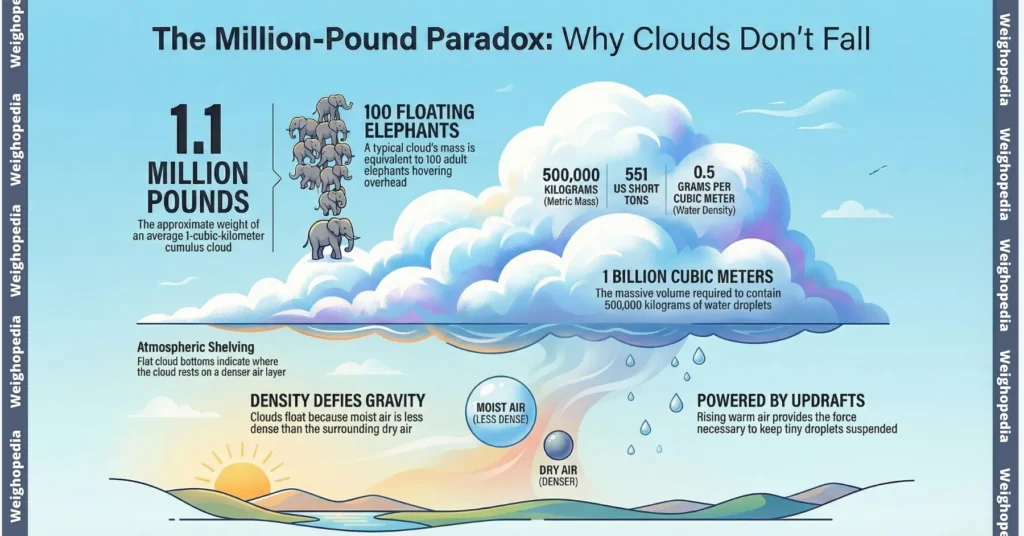
An average cumulus cloud weighs approximately 1.1 million pounds (about 500000 kilograms). That is roughly 551 US tons or the equivalent of 100 elephants floating above your head. (USGS)
Despite this massive weight, clouds stay aloft because their density is lower than the dry air surrounding them.
=
The Heavy Truth About Fluffy Clouds
When we look up at the sky, clouds look like wispy cotton balls or floating marshmallows. They appear weightless, drifting lazily on the breeze. But if you could put a typical “fair weather” cloud on a scale, the reading would shock you.
They look like they are made of nothing, but clouds are composed of a physical substance called water. And as anyone who has ever carried a gallon of water knows, water is heavy.
So, how do scientists measure something that you can’t physically catch, and why does not that 1.1 million pound monster come crashing down on us?
Let’s break down how much does a cloud weigh, the math, the physics, and the mind-blowing reality of cloud weights.
How Much Does a Cloud Weigh? Real Weight
To get a standardized weight, scientists usually look at a cumulus cloud. These are the white, puffy clouds with flat bottoms that you often see on a sunny afternoon.
According to the U.S. Geological Survey (USGS), if you measure a cumulus cloud that is one cubic kilometer in size (1km * 1km * 1km), it contains about 500,000 kilograms of water droplets.
Here is how that translates into units we use every day:
- 1.1 million pounds
- 551 US Tons (Short Tons)
- 500 Metric Tonnes
To visualize this, imagine 100 elephants tied together and hovering in the sky. Or, consider a fully loaded jet plane. A large jet weighs around 600 tonnes, which is fairly close to the weight of the water inside a modest cumulus cloud.
The Science: How Do We Weigh a Cloud?
Obviously, you cannot capture a cloud and drive it onto a truck scale. To “weigh” a cloud, meteorologists use math and radar data.
The formula is actually quite simple, provided by the experts at the USGS:
When it converted to kilograms, that is 500,000 kg. and converted to American units, that is 1.1 million lbs. That is roughly 551 US tons. To put that in perspective, that is 275 times heavier than things that weigh 2 tons, like a large SUV or a rhinoceros.
Why Don’t Clouds Fall If They Are So Heavy?
This is the most common question people ask. If there are 750 cows (based on the average weight of a cow) worth of water above me, why am I not being crushed?
The answer lies in density and thermodynamics.
1. The Density Paradox
Even though the total weight of the cloud is huge, it is spread out over a massive area. The cloud is not a solid brick; it is a mist. The air inside the cloud (moist air) is actually less dense than the dry air surrounding it.
Think of it like a ship. A cruise ship weighs significantly more than a cloud (millions of pounds), yet it floats on water. Why? Because the ship displaces water that weighs more than the ship itself.
Similarly, the cloud floats on the atmosphere because the dry air underneath it is denser and “heavier” than the cloud itself.
2. The Updraft Effect
Clouds are also supported by rising air. Warm air rises (this is called an updraft). These rising columns of air push against the bottom of the cloud, keeping the water droplets suspended. (National Geographic Kids)
The water droplets themselves are incredibly tiny (about 0.002 millimeters across), which is thinner than a human hair. Because they are so small, they lack the “fall velocity” to push through the air resistance.
They just ride the updrafts like a feather on a fan. They will only fall when they clump together to form heavy raindrops that the updrafts can no longer support.
Real-World Analogies: Visualizing the Weight
It can be hard to wrap your head around 1.1 million pounds. Here is a cheat sheet to help you visualize just how much water is floating up there.
Cloud Weight Comparisons Table
| Object | Weight (approx.) | Equivalent Cloud Mass |
| Elephant | 11,000 lbs | 100 Elephants = 1 Average Cloud |
| Ford F-150 | 5,000 lbs | 220 Trucks = 1 Average Cloud |
| Blue Whale | 300,000 lbs | 3.5 Blue Whales = 1 Average Cloud |
| Statue of Liberty | 450,000 lbs | 2.5 Statues = 1 Average Cloud |
| Jet Plane | 600 Tonnes | 0.8 Jets = 1 Average Cloud |

Do Storm Clouds Weigh More?
So far, we have only talked about the nice, fluffy “fair weather” clouds. But what about the scary ones?
Supercell thunderstorms—the kind that produce tornadoes and hail — are exponentially heavier and more powerful.
On the other hand, a cumulus cloud might weigh 500 tons, a major thunderstorm is much denser and much taller. Severe storm updrafts can reach heights of 60,000 feet (about 12 miles high). The water density is much higher because the storm is actively pulling in moisture to fuel itself. (National Weather Service)
When radar scans these storms, meteorologists measure “Vertically Integrated Liquid” (VIL). In severe weather, the mass of the precipitation can be massive. Heavy rain falling on a single square yard of dirt/land can equal roughly 21 gallons of water, or 4 Home Depot buckets worth of weight.
The energy required to keep these massive storm clouds moving is terrifying. An average supercell thunderstorm consumes energy equivalent to a 20-kiloton nuclear detonation, that is roughly 50% more energy than the bomb dropped on Hiroshima, but spread out over hours rather than seconds. (Aviation Safety)
It is also worth remembering that in colder temperatures, this massive weight doesn’t always fall as liquid rain. When cloud moisture freezes into snowflakes, the density changes drastically depending on the water content. If you are wondering how that 1.1 million pounds translates into a winter workout for your shovel, check out our guide on how much does snow weigh.
Frequently Asked Questions (FAQs)
Is a cloud heavier than air?
Technically, no. Moist air (the air inside a cloud) is actually less dense than dry air. This is a concept known as buoyancy. Just like oil floats on water because it is less dense, clouds float on the atmosphere because the air inside them is lighter than the air below them.
How much does a storm cloud weigh compared to a normal cloud?
A storm cloud (cumulonimbus) is much heavier than a fair-weather cumulus cloud. While a normal cloud weighs about 500 tons, a thunderstorm cloud is taller, denser, and packed with rain and hail. It can weigh millions of tons.
If clouds are so heavy, why don’t they crush us?
Clouds are not solid objects; they are a collection of gas and mist. If a cloud fell on you, it would just be fog. The water is spread out over such a massive volume (a billion cubic meters) that the density is very low, only about 0.5 grams per cubic meter.
How many gallons of water are in a cloud?
If a cloud weighs 1.1 million pounds, and a gallon of water weighs roughly 8.34 pounds, then an average cumulus cloud contains approximately 131,894 gallons of water. (Liberty of Congress)
How big is the average cloud used for these calculations?
When scientists say a cloud weighs 1.1 million pounds, they are using a theoretical standard cloud size of 1 cubic kilometer (1km * 1km * 1km). Real clouds vary wildly in size, from tiny wisps to systems covering entire states.
Conclusion
The next time you lie on the grass and watch a cloud drift by, remember that you are looking at a floating reservoir. That single white puff weighs 1.1 million pounds.
This floating mountain of water is held up by the simple laws of physics. It remains one of nature’s coolest magic tricks: hiding the weight of 100 elephants inside a mist that you can walk right through.
For more informative article, keep visiting Weighopedia.com