
How Much Does a Gallon of Gas Weigh? Gasoline Weight Per Gallon
A gallon of gas weighs approximately 6.1 pounds (2.77 kg) on average. This number can shift slightly depending on the gasoline blend, temperature, and ethanol content. Regular unleaded gas typically falls between 5.8 and 6.3 pounds (2.63 to 2.86 kg) per gallon. Diesel fuel is heavier, coming in around 7.1 pounds (3.22 kg) per gallon.
For converting pounds to kilograms, use Weight Calcluator for accurate measurements.
Why People Want to Know the Weight of a Gallon of Gas
Most people never think about how much their fuel actually weighs, until they have a reason to.
Maybe you are loading up a truck bed and need to know how much weight a full tank adds. Or you are calculating fuel load for a boat, an RV, or a small plane. Some folks are just curious after lifting a full gas can and realizing it was way heavier than expected.
Whatever the reason is, knowing the real weight of gasoline is genuinely useful. It affects fuel economy calculations, payload limits, shipping logistics, and even emergency planning when you’re storing extra fuel at home.
This guide gives you the actual numbers in both pounds and kilograms, along with helpful context so the information actually means something to you.
What Affects How Much Gasoline Weighs Per Gallon
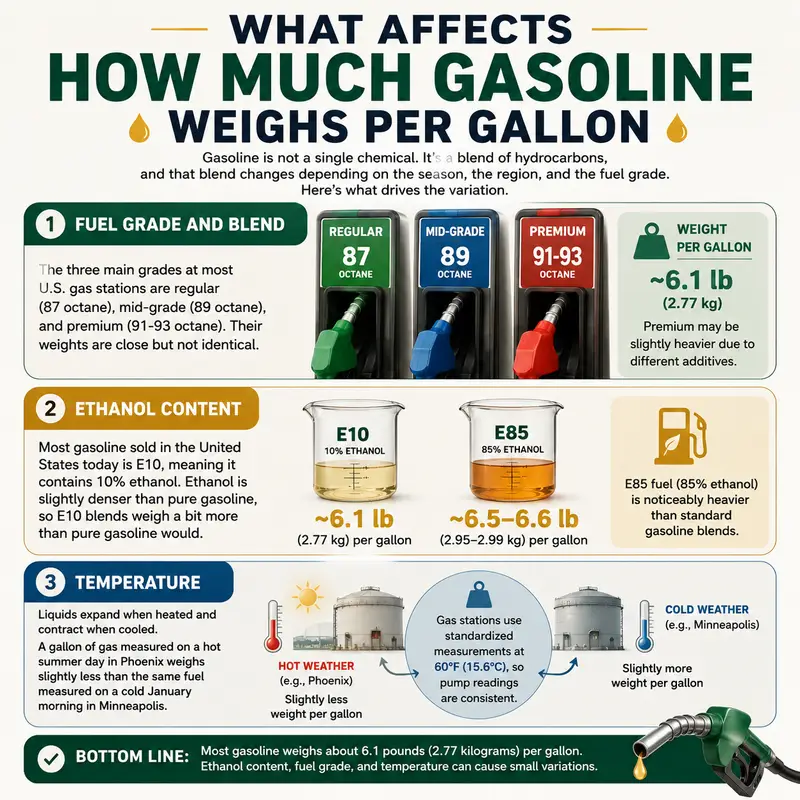
Gasoline is not a single chemical. It’s a blend of hydrocarbons, and that blend changes depending on the season, the region, and the fuel grade. Here’s what drives the variation.
Fuel Grade and Blend
The three main grades at most U.S. gas stations are regular (87 octane), mid-grade (89 octane), and premium (91–93 octane). Their weights are close but not identical.
Regular unleaded gas weighs roughly 6.1 lb (2.77 kg) per gallon. Premium fuel lands in a similar range, sometimes a touch heavier due to different additive packages.
Ethanol Content
Most gasoline sold in the United States today is E10, meaning it contains 10% ethanol. Ethanol is slightly denser than pure gasoline, so E10 blends weigh a bit more than pure gasoline would.
E85 fuel (85% ethanol) is noticeably heavier, coming in around 6.5 to 6.6 lb (2.95 to 2.99 kg) per gallon.
Temperature
Liquids expand when heated and contract when cooled. A gallon of gas measured on a hot summer day in Phoenix technically weighs slightly less per gallon than the same fuel measured on a cold January morning in Minneapolis.
Gas stations use standardized measurements at 60°F (15.6°C), so pump readings are consistent, but stored fuel weight can vary a little with temperature.
How Much Does a Gallon of Gas Weigh by Fuel Type
Here is a straightforward breakdown of the gasoline weight per gallon across common fuel types sold in the United States.
|
Fuel Type |
Weight Per Gallon (lb) |
Weigh Per Gallon (kg) |
|---|---|---|
|
Regular Unleaded (E10) |
6.1 lb |
2.77 kg |
|
Mid-Grade Gasoline |
6.1 – 6.2 lb |
2.77 – 2.81 kg |
|
Premium Gasoline |
6.1 – 6.3 lb |
2.77 – 2.86 kg |
|
E85 Ethanol Blend |
6.5 – 6.6 lb |
2.95 – 2.99 kg |
|
Diesel Fuel |
6.9 – 7.1 lb |
3.13 – 3.22 kg |
|
Aviation Gasoline (Avgas) |
6.0 lb |
2.72 kg |
These are realistic averages based on measured density ranges. Diesel is noticeably heavier than regular gas, which matters if you drive a diesel truck and ever think about payload ratings.
How Much Does a Full Gas Tank Weigh?
Now that you know how much gasoline weighs per gallon, let’s put it into real-world context.
Passenger Cars
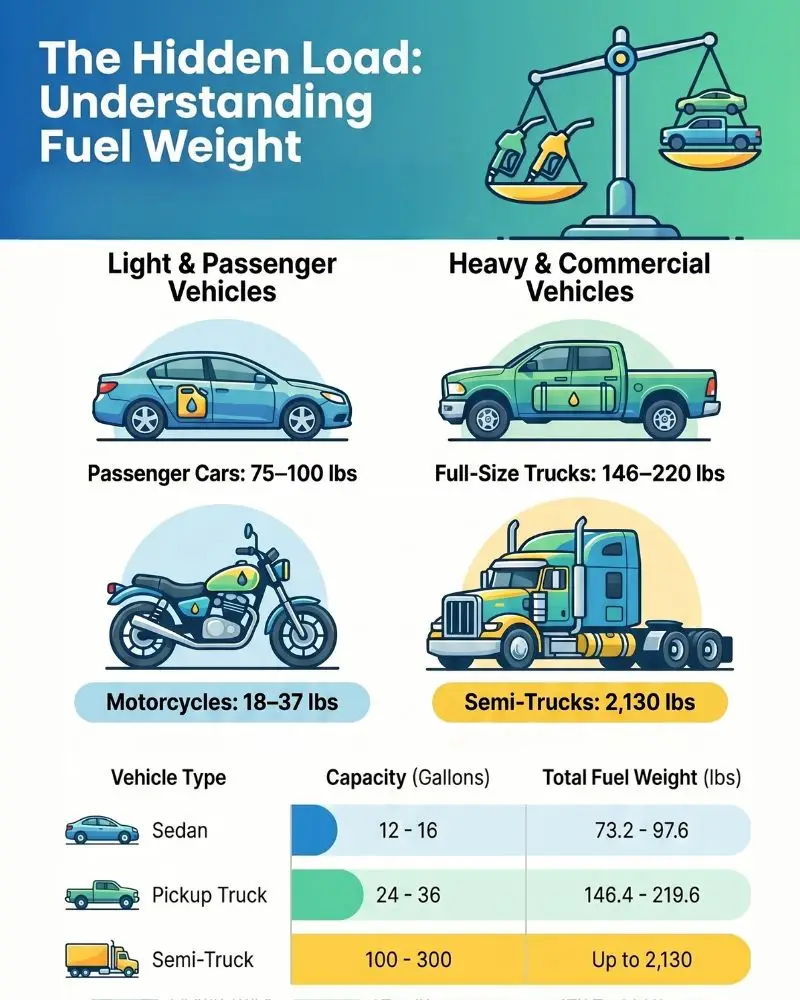
A typical sedan has a fuel tank holding 12 to 16 gallons.
- 12 gallons x 6.1 lb = 73.2 lb (33.2 kg)
- 16 gallons x 6.1 lb = 97.6 lb (44.3 kg)
So a full tank in a standard car adds roughly 75 to 100 pounds of weight. That’s about the same as a large bag of dog food or a small adult passenger.
Pickup Trucks
Full-size trucks like the Ford F-150 or Chevrolet Silverado often have tanks ranging from 24 to 36 gallons.
- 24 gallons x 6.1 lb = 146.4 lb (66.4 kg)
- 36 gallons x 6.1 lb = 219.6 lb (99.6 kg)
A full tank in a big truck can weigh over 200 pounds. That’s worth keeping in mind when you’re calculating payload for hauling.
Motorcycles
Most motorcycle tanks hold 3 to 6 gallons.
- 3 gallons x 6.1 lb = 18.3 lb (8.3 kg)
- 6 gallons x 6.1 lb = 36.6 lb (16.6 kg)
Large Commercial Trucks
Semi-trucks commonly carry 100 to 300 gallons of diesel. At 7.1 lb per gallon, a full 300-gallon load adds about 2130 lb (966 kg) in fuel alone. Fuel weight is a serious factor in commercial trucking regulations.
Gallon of Gas Weight Compared to Other Common Liquids
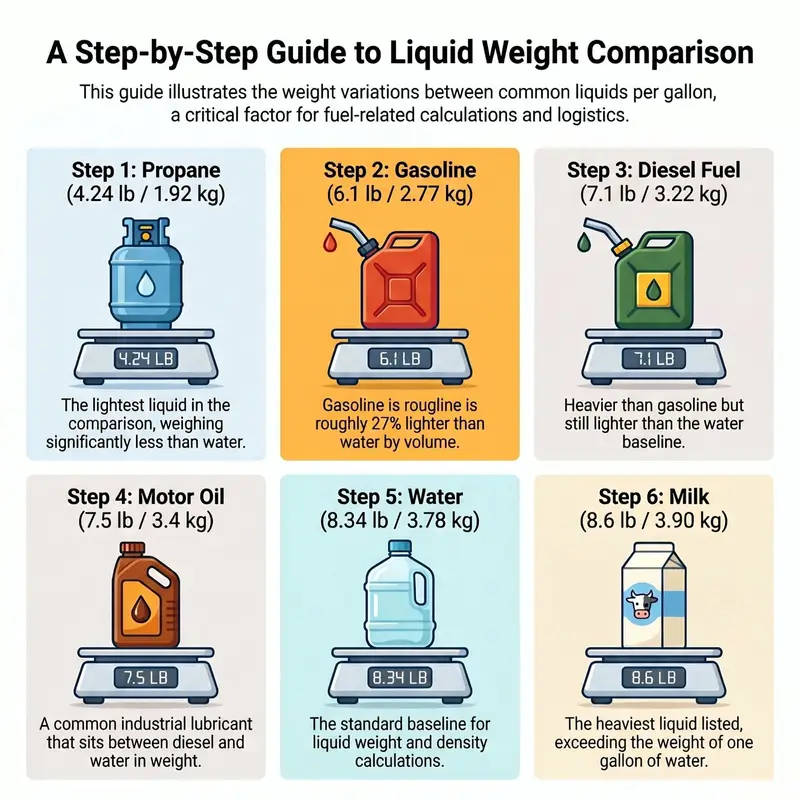
One reason people are often surprised by how much gasoline weighs is that they compare it to water. A gallon of water weighs 8.34 lb (3.78 kg) — noticeably more than gas.
Gasoline is less dense than water, which is exactly why spilled gas floats on top of puddles or pools of water. Understanding density helps explain why the numbers look the way they do.
|
Fuel Type |
Weight Per Gallon (lb) |
Weigh Per Gallon (kg) |
|---|---|---|
|
Water |
8.34 lb |
3.78 kg |
|
Regular Gasoline |
6.1 lb |
2.77 kg |
|
Diesel Fuel |
7.1 lb |
2.77 – 2.86 kg |
|
Milk |
8.6 lb |
3.22 kg |
|
4.24 lb |
1.92 kg |
|
|
Motor Oil |
7.5 lb |
3.4 kg |
Gasoline is roughly 27% lighter than water by volume. That’s a meaningful difference when you’re doing weight calculations for anything fuel-related.
How Much Do Gas Cans Weigh When Full?
Portable gas cans are common for lawn equipment, generators, boats, and emergency fuel storage. Here’s what to expect when you fill one up.
- 1-gallon gas can (full): about 6.1 lb of fuel + can weight (roughly 1 lb) = ~7 lb total
- 2-gallon gas can (full): about 12.2 lb of fuel + can weight = ~13–14 lb total
- 5-gallon gas can (full): about 30.5 lb of fuel + can weight (roughly 2–3 lb) = ~33 lb total
A full 5-gallon gas can weighs over 30 pounds. If you’ve ever carried one across a yard or parking lot, that number probably checks out physically.
How Gasoline Weight Affects Fuel Economy
Here’s something that surprises a lot of people: the more fuel you carry, the worse your fuel economy gets, at least slightly.
Carrying a full tank instead of a half tank adds 50 to 100 pounds to your vehicle depending on tank size. More weight means your engine works harder, which burns more fuel.
On short trips where you don’t need a full tank, topping off every time is actually slightly less efficient than filling to about 75%.
That said, the difference is small in everyday driving. The bigger concern is if you’re hauling extra fuel containers, which can meaningfully affect performance and economy.
Why the Weight of Gasoline Matters More Than You Think
Aviation
Pilots must calculate fuel weight precisely before every flight. Aviation gasoline (Avgas 100LL) weighs about 6.0 lb per gallon (2.72 kg). Even a few gallons of miscalculation can affect aircraft balance and safety.
Boating
Boat owners need to account for fuel weight when calculating total load capacity. A 50-gallon marine fuel tank filled with regular gas adds about 305 lb (138 kg) to the vessel. That’s significant on smaller boats.
Emergency Preparedness
Many Americans store extra fuel for generators during storm season or power outages. Knowing that 5 gallons of gas weighs about 33 pounds (15 kg) helps with storage planning — shelving strength, portability, and container management.
Shipping and Transportation
Businesses that ship vehicles or fuel-related products often need to calculate weights for compliance with DOT regulations and weight limits. Getting these numbers wrong can result in fines or safety hazards.
The numbers in this guide give you a solid working average, but your actual situation depends on the fuel type you use, how many gallons you are carrying, and what you are paying at the pump.
To make those calculations instant and precise, we built the tool below specifically around gasoline weight per gallon. Enter your fuel type, gallons, and current gas price, and it will show you the total weight in both pounds and kilograms alongside your total fuel cost.
Gasoline Weight & Fuel Cost Calculator
Calculate how much your fuel weighs and what it costs — by Weighopedia.com
| Speed (mph) | MPG Adjustment | Weight Used (lb) | Fuel Cost |
|---|
ⓘ Speed adjustments are estimates based on EPA aerodynamic drag data. MPG decreases roughly 7–14% for every 10 mph above 55 mph. Actual results vary by vehicle, load, and conditions. Fuel weights use average density at 60°F (15.6°C).
All weight figures are based on measured density values at the standard 60°F reference temperature used across the U.S. fuel industry, so the numbers you see here reflect real-world gallons of gas weight figures, not rough guesses.
Commonly Asked Questions
Does gasoline weigh more in winter or summer?
Gas is slightly denser in cold temperatures and slightly lighter in warm temperatures. The difference is small — usually less than 1% across typical seasonal temperature ranges in the U.S. — but it is measurable.
Is diesel heavier than gasoline?
Yes. Diesel fuel weighs about 7.1 lb per gallon (3.22 kg), compared to regular gasoline at 6.1 lb per gallon (2.77 kg). Diesel is denser due to its different chemical composition and longer hydrocarbon chains.
Why is gasoline lighter than water?
Gasoline has a lower density than water. Water has a density of about 8.34 lb per gallon, while gasoline averages around 6.1 lb per gallon. This is also why gasoline floats on water rather than mixing with it.
How much does 10 gallons of gas weigh?
Ten gallons of regular unleaded gasoline weigh approximately 61 pounds (27.7 kg). For diesel, the same volume would weigh around 71 pounds (32.2 kg).
How much does 20 gallons of gas weigh?
Twenty gallons of regular gasoline weighs approximately 122 pounds (55.3 kg). This is a common full-tank scenario for mid-size SUVs and light trucks.
Conclusion
Let’s bring it all together with the key numbers.
The weight of a gallon of gas is not a fixed number, but for most everyday planning purposes in the United States, 6.1 pounds (2.77 kg) per gallon is your reliable working figure for regular unleaded gasoline.
Even if you are loading a truck, prepping a generator, calculating boat capacity, or simply satisfying your curiosity, now you have accurate numbers to work with.