
How Much Does a Brick Weigh? By Size, Type and Dimensions
A standard red clay brick typically weighs about 4.5 pounds (2.04 kg). However, weight varies significantly by size and material.
A standard modular brick weighs roughly 4.2 lbs (1.9 kg), while a large dense concrete block can weigh up to 32 lbs (14.5 kg). Always check the specific dimensions and density before calculating load requirements
When you picture a brick, you probably imagine how much does a brick weigh? The classic red rectangle used in schoolhouses and fireplaces. But in the construction world, “brick” is a broad term. You might be dealing with a lightweight veneer for a kitchen remodel, a massive concrete block for a retaining wall, or even a specialized fire brick for a pizza oven.
Knowing the exact weight of your materials matters. No matter if you are calculating how many bricks your pickup truck can haul or designing a foundation that won’t crack under pressure, you need precise numbers.
In this guide, we break down the weights of every major brick type, from standard clay to LEGOs, using real-world data.
If you are comparing different building materials, weight calculations become critical. For example, wood framing weight differs significantly from masonry. You can use our Lumber Weight Calculator to quickly estimate board weight before combining it with brick loads in your project planning.

The Average Weight of Standard Red Bricks
The standard red brick is the baseline for most construction calculations. These bricks turn red due to high clay content reacting to heat in the kiln.
For most DIYers and contractors, a Standard Red Brick weighs approximately 4.5 lbs (2.04 kg). (Real Thin Brick)
However, you cannot assume every red brick weighs exactly the same. Manufacturing plays a huge role here. Even bricks of the exact same size can have different weights due to their internal structure. Some bricks have “pitted” interiors or air pockets resulting from poor construction or specific mold designs. These small voids mean less clay material and a slightly lighter brick.
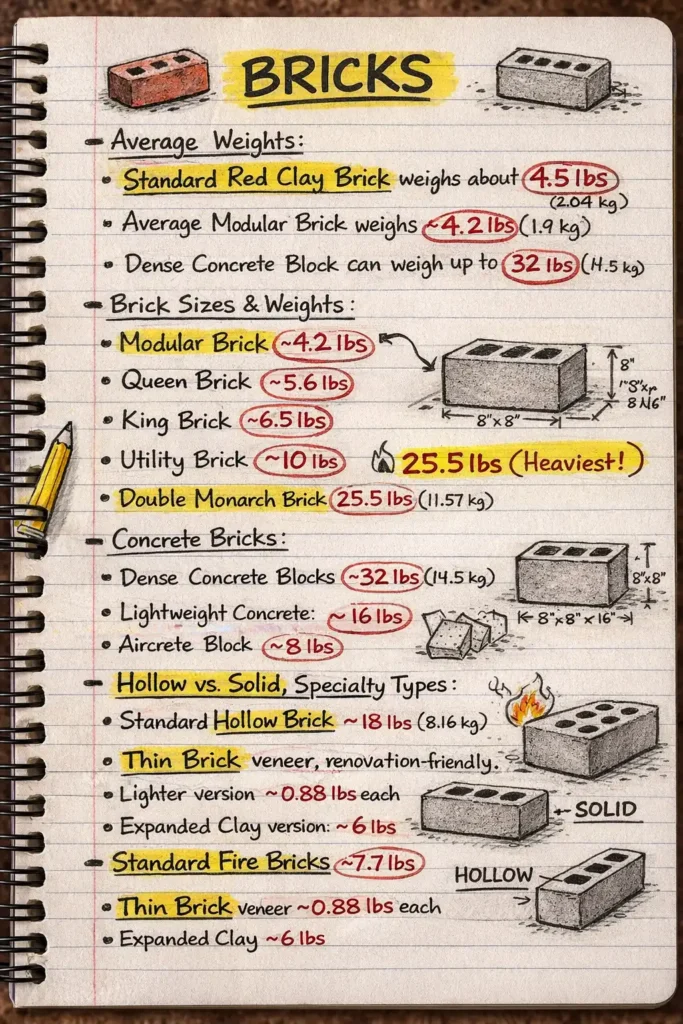
If you are planning a project, industry experts recommend using an average rather than weighing a single brick. For estimation purposes, masonry standards suggest a density range of 120 to 140 pounds per cubic foot for general brickwork.
How Many Grams in a Brick?
A standard red brick weighs about 2040 grams (4.5 pounds or 2.04 kg) on average. However, brick weights typically range between 1500 and 4500 grams (1.5 to 4.5 kg) depending on the brick type, density, and internal air pockets.
For Example
Many common clay bricks weigh 3 to 3.5 kg (3000 to 3500 grams), while heavier engineering bricks can reach 4.5 kg (4500 grams).
In construction terms, these numbers add up quickly. 1000 standard bricks can weigh roughly 3 to 3.5 metric tons, and a pallet of about 500 bricks may weigh around 2250 pounds (1020 kg).
Brick Weight by Size and Dimensions
Size is the most obvious factor changing a brick’s weight. Manufacturers like The Belden Brick Company produce a wide array of sizes to fit different architectural styles, and the weight jumps drastically as you move up from “Modular” to “Monarch” sizes
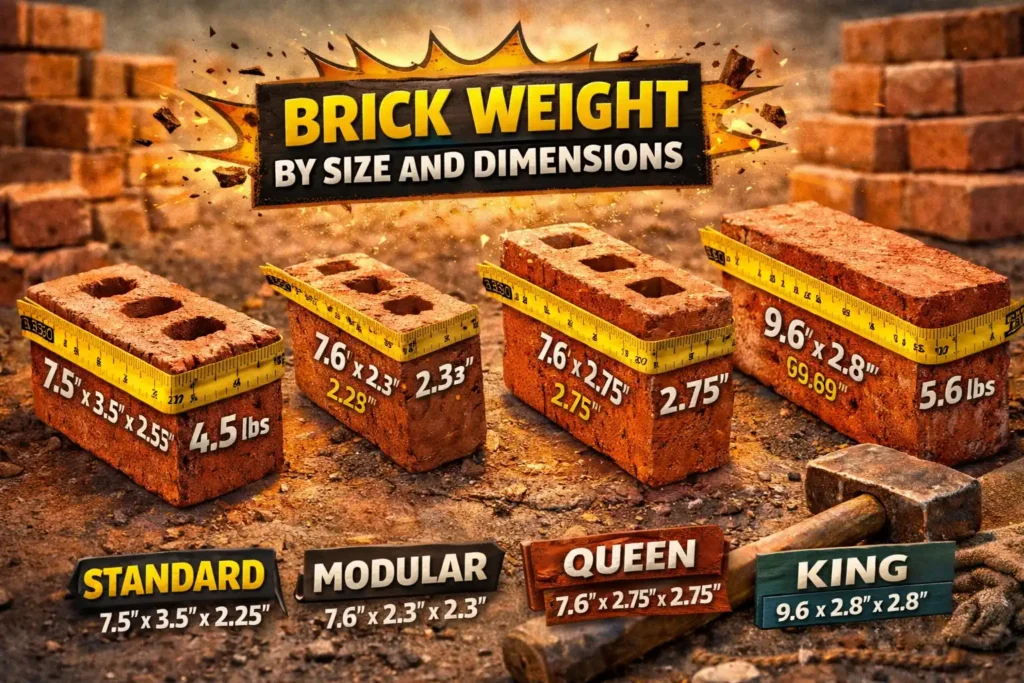
Modular vs. King and Queen
These are the most common bricks used in modern construction. They are slightly smaller and lighter than the older standard bricks, weighing in at 4.2 lbs (1.9 kg).
A queen brick is taller than a standard brick but often thinner in depth. These weigh approximately 5.6 lbs (2.54 kg).
These are significantly larger and are often used to reduce mortar costs (fewer bricks cover more space). A king-size brick weighs about 6.5 lbs (2.95 kg).
Large-Format Bricks
When you enter the territory of commercial construction or large estate homes, architects often specify massive bricks to create a distinct look.
Clay Brick Weight Comparison
| Brick Type | Dimensions (Approx) | Weight (lbs) | Weight (kg) |
|---|---|---|---|
| Thin Brick | 7-5/8″ x 2-1/4″ x 3/8″ | 0.88 lbs | 0.40 kg |
| Modular | 3-5/8″ x 2-1/4″ x 7-5/8″ | 4.2 lbs | 1.90 kg |
| Standard Red | 3-5/8″ x 2-1/4″ x 8″ | 4.5 lbs | 2.04 kg |
| Roman | 3-5/8″ x 1-5/8″ x 11-5/8″ | 4.7 lbs | 2.13 kg |
| Queen | 3-1/8″ x 2-3/4″ x 9-5/8″ | 5.6 lbs | 2.54 kg |
| King Size | 7-5/8″ x 3-5/8″ x 4-1/2″ | 6.5 lbs | 2.95 kg |
| Utility | 3-5/8″ x 3-5/8″ x 11-5/8″ | 10.2 lbs | 4.63 kg |
| Double Monarch | 3-5/8″ x 7-5/8″ x 15-5/8″ | 25.5 lbs | 11.57 kg |
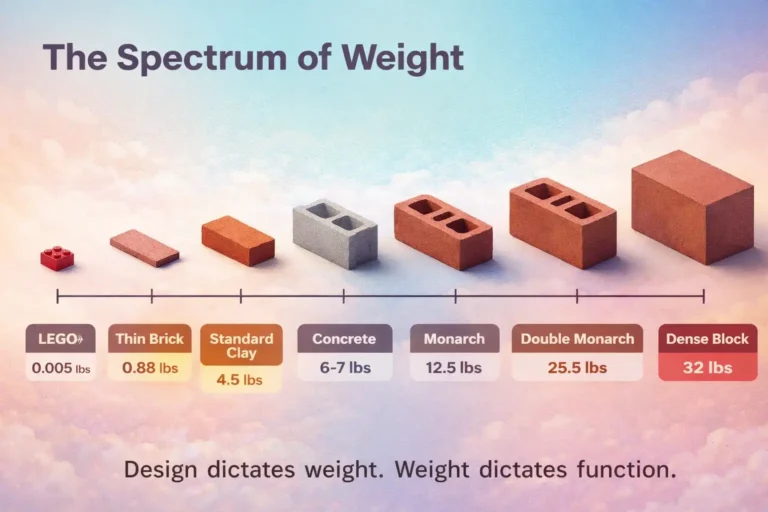
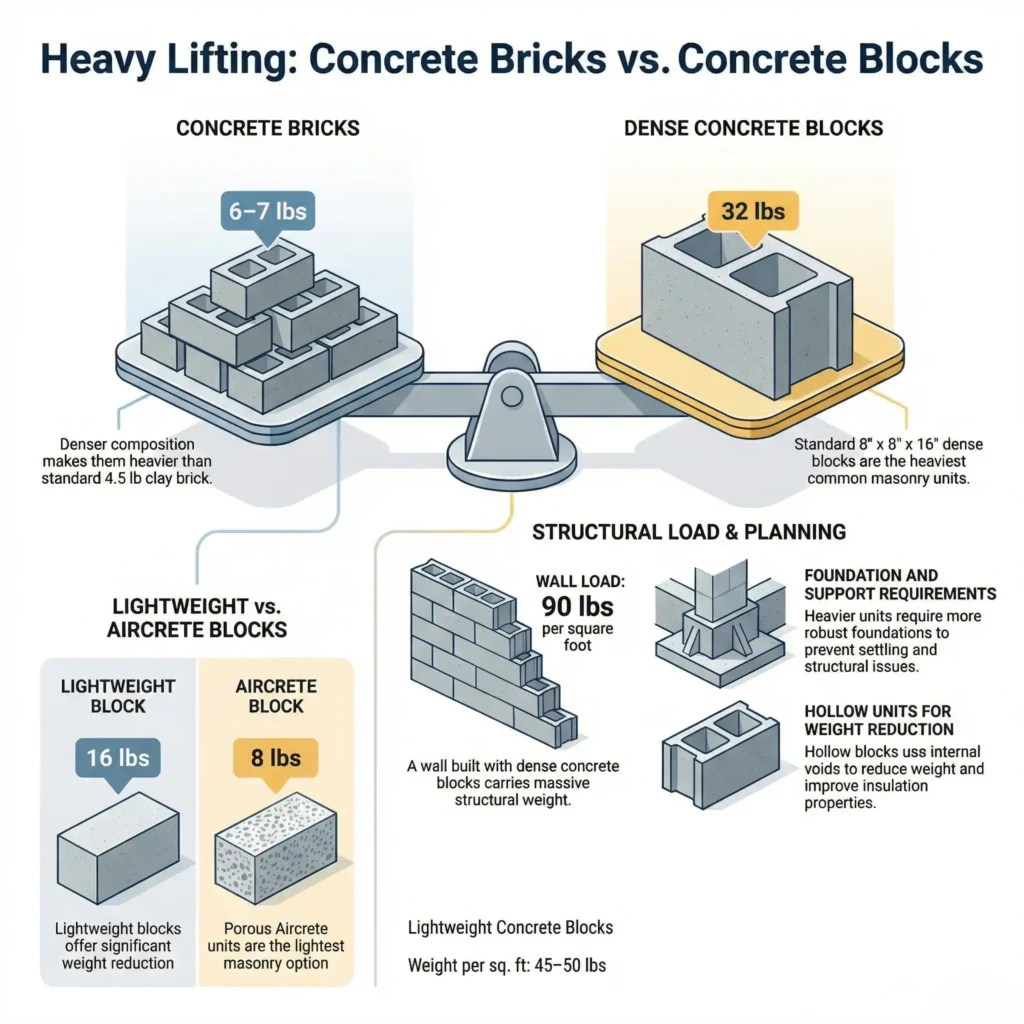
Concrete Brick vs. Concrete Block Weights
Concrete behaves differently than clay. It is generally denser, and the weight depends heavily on the aggregate (the stone and sand mix) used during manufacturing.
The Dense Concrete Block
You likely know these as “cinder blocks” or CMUs (Concrete Masonry Units). A standard Dense Concrete Block (8″ x 8″ x 16″) is heavy, weighing roughly 32 lbs (14.5 kg). Builders use these for load-bearing walls and foundations where mass equals stability. A dense concrete block wall can weigh up to 90 lbs per square foot.
Lightweight and Aircrete
Not all concrete is heavy. Innovations in building materials have led to lighter options that save on shipping and labor.
- Lightweight Concrete Block: These use lighter aggregates (like shale or clay) to drop the weight to approximately 16 lbs (7.26 kg).
- Aircrete (Aerated Concrete): By introducing air pockets into the mix, manufacturers create blocks that weigh as little as 8 lbs (3.63 kg). These are excellent for insulation but have different structural properties than dense blocks.
Hollow vs. Solid Brick Weights
If you pick up a brick and it feels surprisingly light, check for holes. Manufacturers often create hollow bricks or cored bricks. These voids account for 25% to 60% of the brick’s bed area.
A Standard Hollow Brick (8″ x 8″ x 16″) weighs about 18 lbs (8.16 kg). While this is significantly lighter than a solid block, the holes serve a second purpose: insulation. The air trapped inside the wall helps regulate temperature.
For extreme weight reduction, builders might use Expanded Clay Hollow Bricks, which can weigh as little as 6 lbs (2.72 kg). These are fantastic for upper-story additions where you want to minimize the load on the existing structure below.
Thin Brick and Veneer Weights
If you love the look of exposed brick but don’t have a reinforced concrete slab to support a heavy wall, thin brick is the solution.
Designed specifically for remodeling and veneers, thin bricks are slices of real brick that typically measure only 3/8″ to 1/2″ thick.
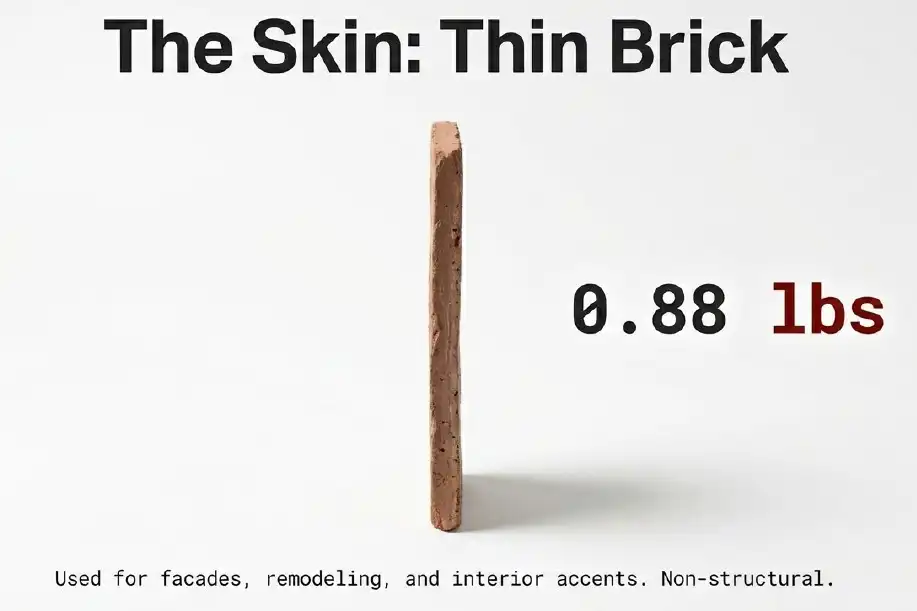
Because they are so light, you can install them on drywall or existing flooring without adding extra structural support. This makes them a favorite for DIY fireplace makeovers and kitchen backsplashes.
Specialty Bricks: Fire, Pavers, and Roman
Bricks aren’t just for walls. Different jobs require bricks with special chemical compositions or shapes, which changes their mass.
Used in kilns, furnaces, and pizza ovens, these must withstand extreme heat. A standard fire brick weighs 7.7 lbs (3.5 kg).
High-temperature versions are denser and can weigh up to 9 lbs (4.1 kg), while insulating fire bricks (which are porous) are lighter at about 5 lbs (2.3 kg).
Bricks you walk on need to be dense to resist cracking. A standard Clay Paver weighs about 8 lbs (3.63 kg), while a Concrete Paver is heavier at roughly 12 lbs (5.44 kg)
These are long, slender bricks often seen in mid-century modern architecture. Despite their length, their short height keeps them relatively light at 4.7 lbs (2.13 kg).
How Much Does a LEGO Brick Weigh?
Perhaps you aren’t building a house but a science project. A common question for students (and curious AFOLs—Adult Fans of LEGO) is regarding the weight of these plastic bricks.
A standard 2×4 LEGO brick weighs approximately 2.22 grams to 2.5 grams. A smaller 1×4 LEGO brick weighs approximately 1.6 grams to 1.7 grams.
Why the range? LEGO molds are expensive and change over time. Some bricks have hollow tubes on the underside, while others are solid. Furthermore, different colors of plastic have slightly different densities. A transparent brick, for example, is made of a different material (polycarbonate) than a standard opaque brick (ABS), which changes the weight.
Fun Fact…
In the LEGO world, scale matters. The “Minifigure scale” is roughly 1:40 compared to the real world. If you were to scale real-world weights down to LEGO size, a metric ton would equal about 13.33 LEGO pounds
Calculating Weight for Construction Projects
Knowing the weight of a single brick is helpful, but in construction, you buy them by the pallet. Here is how the math adds up for a standard red brick project.
The “Bricks per Ton” Rule
If you are ordering bulk materials, a good rule of thumb is that 444 standard red bricks equal one ton. This calculation assumes the average 4.5 lb weight.
Pallet Weight
A typical pallet contains about 500 standard bricks.
Math: 500 bricks x 4.5 lbs = 2,250 lbs (approx. 1,020 kg).
This implies you generally need a heavy-duty truck (like a 3/4-ton or 1-ton pickup) or a trailer to haul a full pallet safely.
Total House Weight
Have you ever wondered how much the brick veneer on a house weighs? For a typical 2,000 square foot, two-story home, the brick facade alone can weigh between 200,000 and 300,000 lbs. This immense weight explains why brick homes require substantial concrete footings compared to vinyl-sided homes.

If you’re estimating total material weight for a project, you may also want to check how much a yard of dirt weighs. Soil, like brick, varies in density depending on moisture and composition, and knowing both helps you plan truck capacity and foundation loads accurately.
Why Brick Weight Matters
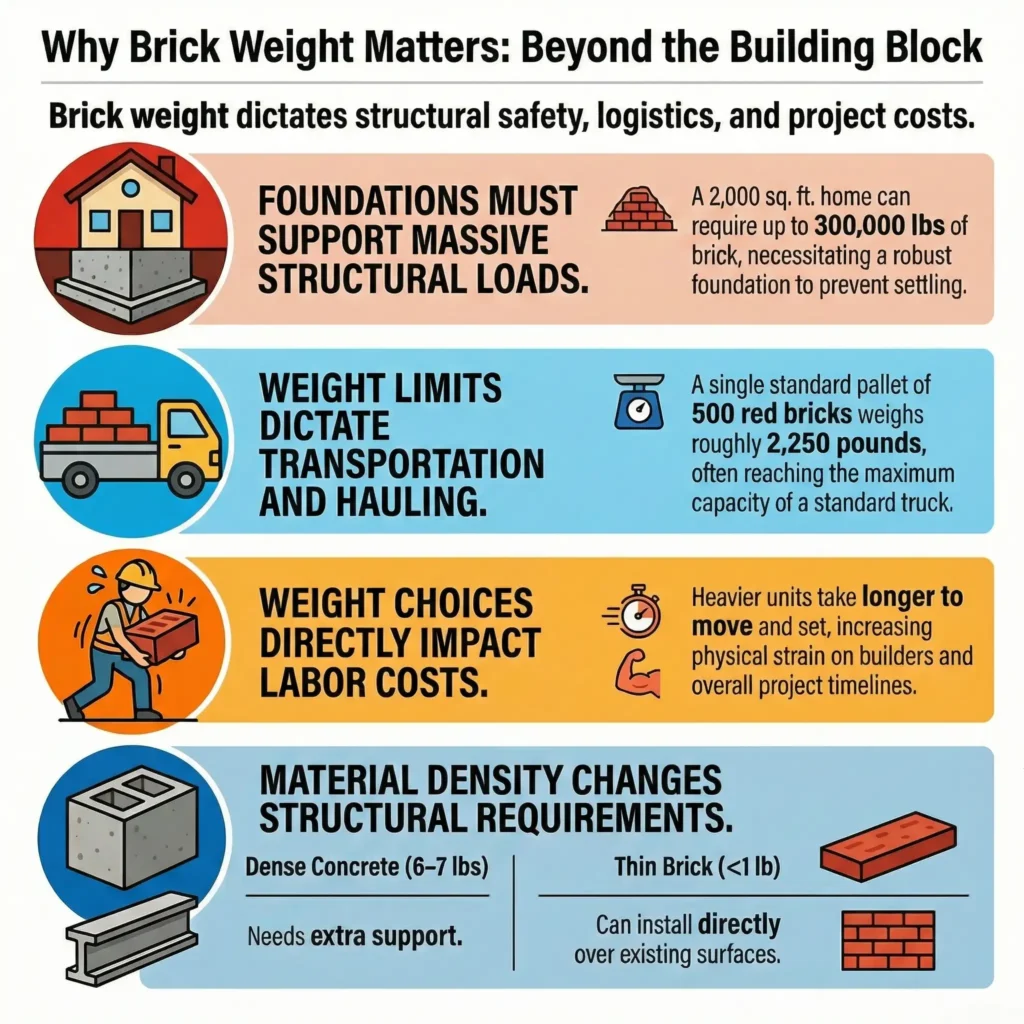
The weight of your material dictates almost every logistical decision in a project.
You cannot simply load a pallet of “Monarch” bricks into a light-duty truck. Knowing the weight prevents vehicle damage and dangerous driving conditions
Heavy bricks like the Quad (14.1 lbs) or Double Monarch (25.5 lbs) are excellent for load-bearing walls, but they require specific foundation widths. You cannot swap these in for standard bricks without an engineer approving the load capacity.
Lighter options like Aircrete or Thin Brick speed up installation. A mason lifts hundreds of bricks a day; a difference of 2 lbs per brick adds up to tons of saved energy over a week
Frequently Asked Questions (FAQs)
1. What is the heaviest type of brick generally available?
The Double Monarch brick is among the heaviest commercial bricks, weighing approximately 25.5 lbs (11.57 kg). In terms of standard blocks, a dense concrete block can weigh up to 32 lbs (14.5 kg).
2. How Much Does 1000 Bricks Weigh?

1000 standard bricks weigh approximately 4500 to 5000 pounds (2040 to 2268 kg). A single standard brick weighs around 4.5 to 5 pounds, so multiply that by 1000 for your total.
Always confirm the exact brick type with your supplier, as weights vary across brick sizes and materials.
3. How many bricks fit on a standard pallet?
A typical pallet holds about 500 standard red bricks. Given that each weighs ~4.5 lbs, a full pallet weighs over a ton (approx. 2,250 lbs)
4. Do different brick colors weigh different amounts?
For clay construction bricks, the color (which comes from clay composition and firing time) has a negligible effect on weight compared to size and density.
However, for plastic LEGO bricks, different colored plastics and transparent variations do have slight density differences that can affect precision weighing
5. How much does a fire brick weigh compared to a normal brick?
A standard fire brick weighs about 7.7 lbs (3.5 kg). This is heavier than a standard red brick (4.5 lbs) because fire bricks are denser to withstand extreme thermal shock
6. What is the weight of brick per cubic foot?
The general density for brickwork is approximately 120 to 140 pounds per cubic foot. This figure helps engineers calculate the total load a wall will place on a foundation
Conclusion
Bricks are not a “one size fits all” material. While it is safe to estimate a standard red brick at 4.5 lbs, your project might involve a featherweight 0.88 lb thin brick or a massive 32 lb concrete block.
By understanding these weights, you can plan your transportation, estimate your structural needs, and choose the right material for the job.
No matter if you are building a barbecue pit, a two-story home, or just a LEGO castle, getting the weight right is the first step toward a solid build.