
How Much Does Snow Weigh? Know the Roof Snow Load by Zip Codes
On average, fresh and fluffy snow weighs about 3 to 4 pounds (1.3 to 1.8 kg) per cubic foot. However, heavy and wet snow is much denser. It can weigh between 25 and 52 pounds (11 to 23 kg) per cubic foot.
A general rule for roofing is that 1 inch of snow creates about 1 pound of pressure per square foot. Ice is the heaviest. It weighs roughly 57 pounds (26 kg) per cubic foot.
How Much Does Snow Weigh Per Cubic Foot?
When you look out the window at a winter wonderland, the snow looks light and airy. It is easy to forget that snow is simply frozen water. The weight of that snow depends entirely on its density. This is how much water is packed into a specific amount of space.
Scientists and engineers measure this using “pounds per cubic foot” (lb/ft³). Imagine a box that is one foot wide, one foot long, and one foot tall. If you filled that box with water, it would weigh 62.4 pounds (28.3 kg). Snow is less dense than water because it contains air. (Town of Monroe)
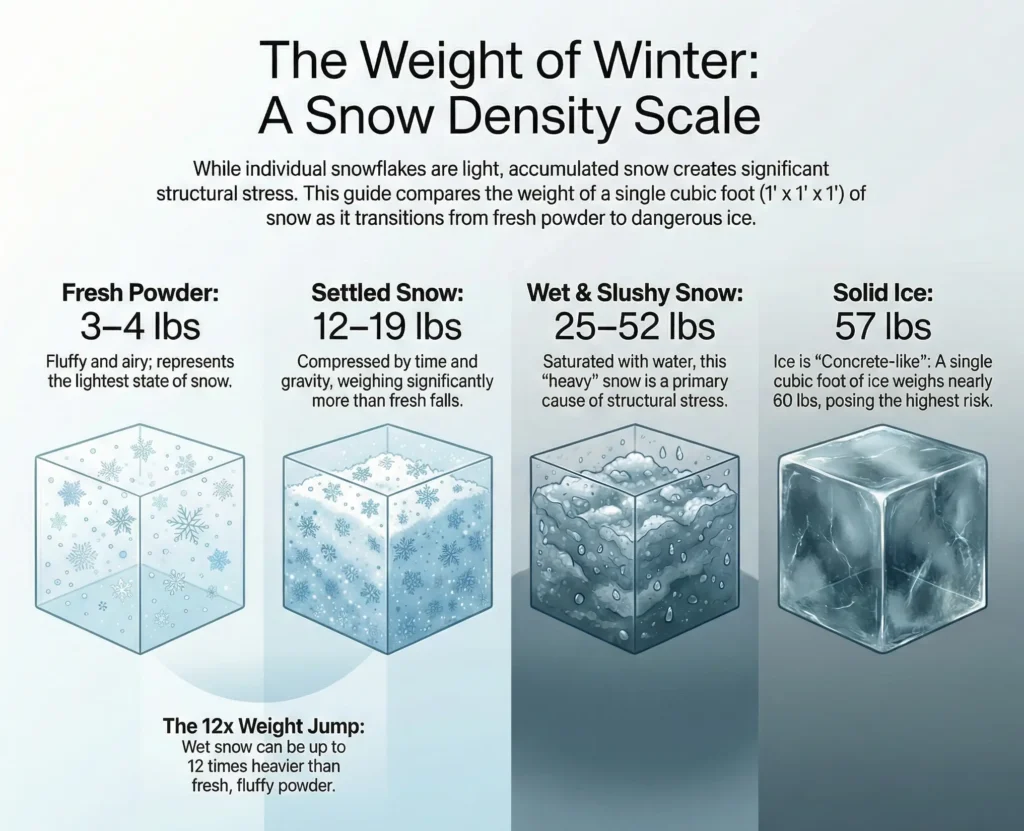
When snow first falls on a cold day, it is full of air. This fresh powder is very light. It typically weighs between 3.0 and 4.4 pounds (1.4 to 2.0 kg) per cubic foot.
As the snow sits on your driveway or roof, gravity takes over. The delicate ice crystals break and compress. This process is called settling.
Settled snow is denser and weighs significantly more. You can expect settled snow to weigh 12 to 19 pounds (5.4 to 8.6 kg) per cubic foot.
Temperature plays a massive role here. If the temperature is near freezing (32°F / 0°C), the snow will be wet. Wet snow is heavy and sticky. This “slushy” snow packs a lot of water content into a small space.
Wet snow can weigh anywhere from 25 pounds (11.3 kg) up to nearly 52 pounds (23.5 kg) per cubic foot. That is over ten times heavier than fresh powder.
Ice is the biggest threat to structures. If snow melts and refreezes, it turns into solid ice.
One cubic foot of ice weighs approximately 57.2 to 57.5 pounds (26 kg). This is almost as heavy as pure water.
Weight of Snow by Type
|
Snow Type |
Density (lbs per Cubic Foot) |
Density (kg per Cubic Meter) |
|---|---|---|
|
Fresh / Light Snow |
3 – 4.4 lbs |
50 – 70 kg |
|
Damp Fresh Snow |
6 – 7 lbs |
96 – 112 kg |
|
Settled Snow |
12 – 19 lbs |
200 – 300 kg |
|
Wind-Packed Snow |
22 – 25 lbs |
350 – 400 kg |
|
Wet / Slushy Snow |
25 – 52 lbs |
400 – 830 kg |
|
Solid Ice |
57.2 lbs |
916 kg |
Understanding Roof Snow Load by Zip Code
You might wonder why a house in Florida has a different roof structure than a house in Minnesota. The answer lies in local building codes and the “Ground Snow Load.”
What is Ground Snow Load?
Engineers use a standard known as ASCE 7-10. This was developed by the American Society of Civil Engineers. They map out the United States by Zip Code to determine the expected snow load for that specific area. This is based on decades of historical climate data. (Engineering Express)
This number tells builders how much weight the snow on the ground is expected to exert. However, the load on your roof is different. Wind often blows snow off a roof. Heat from the house can melt it. Therefore, the “Roof Snow Load” is usually calculated as a percentage of the Ground Snow Load.
Regional Variations It is critical to know your zone.
- The Midwest: Regions like Minnesota or Wisconsin often have high snow load requirements because snow stays on the roof for months.
- Pacific Northwest: Areas with wetter climates may see heavy, wet snow. This requires strong roofs even if the total depth of snow is lower than in the mountains.
- Lake Effect Zones: Zip codes near the Great Lakes (like Buffalo, NY) have extreme requirements due to rapid, heavy accumulation.
You can find the specific requirements for your Zip Code by checking with your local building department or using online ASCE hazard tools.
How Much Snow Can My Roof Support?
Most homeowners worry about their roof collapsing during a blizzard. The good news is that building codes are designed to keep you safe. However, the age and style of your home matter.
The 20-Pound Rule: There is a general safety standard for residential roofs in the United States. Most roofs are built to support a minimum of 20 pounds per square foot (97 kg per square meter) before the structure becomes stressed. This is often referred to as the “live load” capacity.
Newer vs. Older Homes:
Construction standards have improved over time.
- Modern Homes: If your home was built after the 1970s, it likely meets stricter codes. Many modern roofs in snowy regions are rated for 40 pounds per square foot (195 kg per square meter) or more.
- Older Homes: Houses built in the early 1900s may not meet these modern standards. They might only safely hold 30 pounds per square foot (146 kg per square meter).
- Manufactured Homes: Until recently, many manufactured homes were only designed for a load of 30 pounds per square foot. You should check the metal certification label on the home to be sure.

Flat vs. Pitched Roofs
A pitched roof has gravity on its side. The steep angle helps snow slide off. A flat roof does not have this advantage.
Flat roofs (often found on porches, garages, or commercial buildings) are at much higher risk. They hold all the weight until it melts or is physically removed. A flat roof with poor drainage can accumulate massive weight very quickly.
If you are amazed by the crushing weight of snow on your roof, you might be surprised to learn how much a cloud weighs before that precipitation even falls.
Calculating the Weight of Snow on Your Roof
You do not need to be a mathematician to estimate the danger. There are simple ways to guess the weight resting over your head.
The “One Inch” Rule of Thumb
For a quick estimate, you can follow this rule:
1 inch (2.54 cm) of average snow depth equals about 1 pound (0.45 kg) per square foot of weight.
- If you have 12 inches of snow, you likely have about 12 pounds of pressure per square foot.
- If you have 24 inches of snow, you have about 24 pounds of pressure per square foot.
This rule works well for “average” snow. If the snow is very wet, you need to be more careful. Wet snow can weigh nearly 2 pounds per inch of depth.
The Water Equivalent Method
Meteorologists often talk about the “Snow Water Equivalent” (SWE). This measures how much water is in the snowpack.
- 10 to 12 inches of fresh snow usually equals 1 inch of water.
- 1 inch of water weighs exactly 5.2 pounds per square foot. So, if the weather report says you received 12 inches of fresh snow, your roof is holding about 5.2 pounds per square foot. This is well within the safe zone for a standard 20-pound roof.
Estimated Roof Load by Depth
| Snow Depth | Snow Condition | Estimated Load (per Sq Ft) | Risk Level (Standard Roof) |
|---|---|---|---|
| 6 Inches | Fresh / Fluffy | ~1.5 lbs (0.7 kg) | Safe |
| 6 Inches | Wet / Heavy | ~10 lbs (4.5 kg) | Safe |
| 12 Inches | Settled / Average | ~12 lbs (5.4 kg) | Safe |
| 12 Inches | Wet / Heavy | ~20+ lbs (9+ kg) | Caution |
| 24 Inches | Settled / Average | ~25 lbs (11.3 kg) | Danger |
| 24 Inches | Wet / Heavy | ~40+ lbs (18 kg) | High Danger |
Real-World Examples: The “Car” Analogy
Numbers on a page can be hard to visualize. It helps to compare the snow load to something heavy that we see every day.
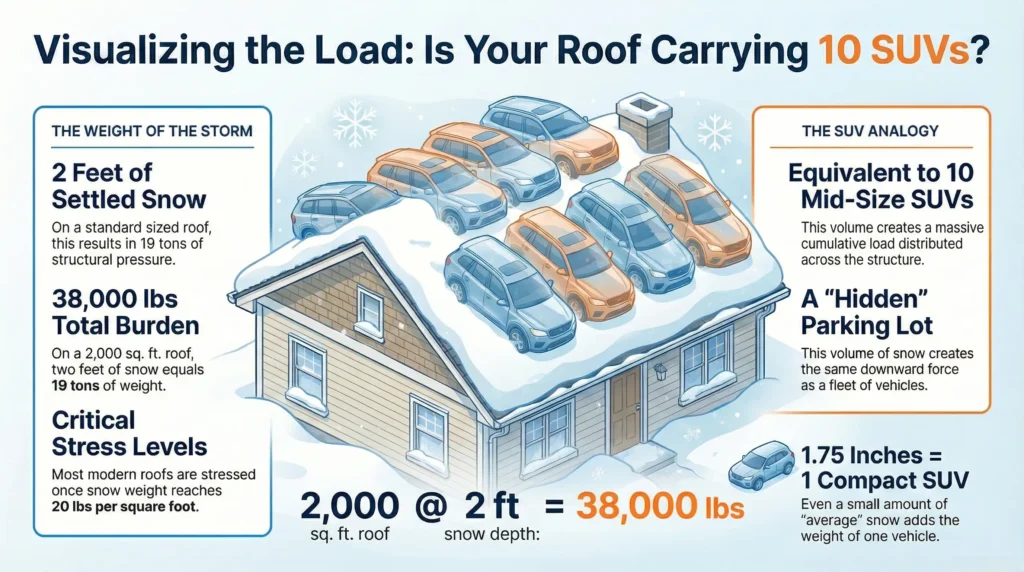
Let’s imagine a standard American home. The roof is about 2,000 square feet (185 square meters). If a major storm dumps 2 feet (24 inches) of average settled snow on that roof, we can do the math.
- 2,000 square feet × 19 pounds per square foot (for settled snow) = 38,000 pounds.
That is 19 tons of weight sitting on your house. To put that in perspective, the average mid-size SUV weighs about 2 tons (3,500 to 4,000 pounds). Having 2 feet of snow on your roof is roughly the same as parking 10 SUVs on top of your shingles.
This visualization helps explain why structural collapses happen. The wood trusses in your attic are strong, but every material has a breaking point.
The Impact of Rain on Snow
The most dangerous weather event for a roof is rain falling onto existing snow. You might think the rain will wash the snow away. Usually, the opposite happens.
The Sponge Effect
Deep snow acts like a dry sponge. When it rains, the snow absorbs the water. It holds onto it. The water does not run off into the gutters. This means the load on your roof increases instantly. If you have 1 foot of snow (approx. 6 lbs/sq ft) and you get 1 inch of rain, you simply add the weight of the rain to the snow.
- 1 inch of rain = 5.2 lbs/sq ft. (Weather.gov)
- Total new weight = 11.2 lbs/sq ft.
The depth of the snow might look the same, or it might even look lower because it is melting. But the weight has doubled. This hidden weight is what causes many roof failures during late winter storms.
Freeze-Thaw Cycles
If that wet “sponge” freezes at night, it turns into a block of ice. Ice is not fluffy. It distributes weight aggressively. A cycle of thawing during the day and freezing at night can create layers of ice that exceed the 20 to 30 PSF safety limits of older homes.
Warning Signs of Excessive Snow Load
Your house will usually talk to you before it fails. You should pay attention to these sensory warning signs.
If you hear popping, cracking, or creaking sounds coming from the ceiling or the attic, take action immediately. These sounds often mean the wood framing is under extreme tension.
This is a classic sign of structural stress. If interior doors that usually open freely suddenly stick or jam, the door frame has shifted.
The weight of the snow is pushing down on the walls of the house, distorting the frames. This is a red flag that you have exceeded your snow load capacity.
Go outside and look at the ridge line (the very top peak) of your roof. It should be perfectly straight. If it looks like a saddle or has a dip in the middle, you are in the danger zone.
The same applies to ceiling drywall inside the house. If the ceiling bows downward, the structure is compromised.
Ice Dams and Their Weight
Snow is not the only enemy. Ice dams are heavy ridges of solid ice that form at the edge of your roof line.
How They Form
Ice dams happen when the attic is too warm. Heat escapes through the roof and melts the bottom layer of snow. This water runs down the roof until it hits the cold eaves (the overhang). There, it refreezes. Eventually, this creates a wall of ice that traps water behind it.
Concentrated Weight
Ice weighs about 57 pounds per cubic foot (913 kg per cubic meter). An ice dam concentrates hundreds of pounds of force onto the delicate overhang of your roof. This is the weakest part of the roof structure. It can tear off gutters and cause the eaves to collapse, even if the rest of the roof is fine.
Safe Snow Removal: When to Rake Your Roof
Should you remove the snow? The answer is generally yes, but only if you can do it safely.
- A good guideline is to clear your roof when snow accumulation reaches 2 feet (24 inches). If you have a flat roof or an older home, you should clear it sooner, perhaps at 12 inches.
- Use the Right Tools Never climb a ladder to shovel a snowy roof. It is slippery and incredibly dangerous. Instead, use a roof rake. This is a long, telescoping pole with a flat blade or rollers at the end. You stand safely on the ground and pull the snow down towards you.
- Do not try to scrape the roof perfectly clean. You risk ripping off the asphalt granules that protect your shingles. Leave a thin layer of snow (about 1 or 2 inches) as a buffer. This protects the roofing material from the metal edge of the rake.
Frequently Asked Questions (FAQs)
1. How do I know if my roof snow load is too heavy?
Look for the warning signs. If your interior doors become difficult to close, your ceiling drywall shows cracks, or you hear loud popping noises from the attic, the load is too heavy. Generally, if you have more than 2 feet of snow, you are approaching the safety limit for standard residential roofs.
2. Does a snow blower work on a flat roof?
Using a snow blower on a roof is risky. However, if you have a large flat commercial roof or a sturdy deck, it is possible. You should use a single-stage snow blower. These machines weigh about 100 pounds (45.36 kg), which is much lighter than two-stage machines that can weigh over 200 pounds (90 kg). Always use a machine with rubber paddles to avoid damaging the roof surface.
3. What is the difference between ground snow load and roof snow load?
Ground snow load is the weight of snow on the ground as defined by building codes for your Zip Code. Roof snow load is usually lower. This is because wind blows some snow off, and heat from the building melts some of it. Engineers use the ground load to calculate the required strength of the roof.
4. How much does a cubic foot of slush weigh?
Slush is very heavy. While fresh snow weighs about 3 to 4 pounds per cubic foot, slush (wet snow) can weigh between 25 and 52 pounds (11 to 23 kg) per cubic foot. This is why slush is so difficult to shovel and dangerous for roofs.
5. Will rain wash the snow off my roof?
No. Rain usually makes the problem worse. Snow acts like a sponge and absorbs the rain. This adds the weight of the water to the weight of the snow. A heavy rain on top of deep snow can instantly double the stress on your roof structure.
6. How much does an adult snow leopard weigh?
Adult snow leopards generally weigh between 60 and 120 pounds (27 to 54 kg). They are sexually dimorphic, meaning males are larger than females. Adult males typically weigh 99 to 121 pounds (45 to 55 kg), while females usually range from 77 to 88 pounds (35 to 40 kg)
Conclusion
Knowing how much snow weighs is more than just interesting trivia; it is a matter of home safety. While a cubic foot of fresh snow might only weigh 3 pounds, that weight adds up quickly. A deep accumulation of settled snow can create tons of pressure on your home.
Always keep an eye on the depth of the snow. If it approaches 2 feet, or if you notice warning signs like sticking doors, it is time to grab a roof rake.
Remember to stay on the ground and stay safe. By monitoring the load and reacting to heavy wet snow or ice, you can protect your home through the harshest winters.