Scale-Free Kitchen: How to Measure Grams Without a Scale – 3 Proven Methods
We have all been there: halfway through a crucial recipe, perhaps a delicate baking project. When you realize the ingredients are listed in grams, and your kitchen scale is missing, broken, or simply doesn’t exist.
Since the gram is the basic unit of measurement for weight and mass in the metric and SI measurement systems, and is often used to weigh small items like dry kitchen goods, knowing how to measure this unit accurately is essential.
While the only truly accurate way to measure grams is by using a scale, that does not mean your culinary dreams are dashed. If you need a rough estimate for cooking or a clever DIY hack for better precision, there are several methods, using common household tools, that can save your recipe.
Before moving on to the scale-free methods, it’s important to first get a clear understanding of the difference between mass and volume.
For a better understanding of weighing, you can read a masterpiece on things that weigh 50 pounds.

The Precision Imperative: Why Grams Matter
Measure grams without a scale is a tricky thing as Grams measure mass, while tools like cups and tablespoons measure volume. This distinction is critical because all items have differing weights.
A cup of flour will not weigh the same as a cup of nuts or herbs. Even two different types of coffee grounds can vary in weight per cup.
For baking recipes requiring precision, using a kitchen scale that measures ingredients by weight is crucial. Baking is often referred to as chemistry, where exact quantities make a world of difference.
Conversely, cooking (outside of baking) is more of an art, and measurements in grams are often general guidelines, allowing for some flexibility.
For beginners in baking, however, consistency is paramount, and a scale simplifies the process immensely.

How to Measure Grams with a Spoon?
To measure grams with a spoon, you are converting volume (space) into weight (mass). Because ingredients have different densities, the gram weight of a “spoonful” changes depending on what you are measuring
Here is the step-by-step method and a guide to common conversions.
Common Ingredient Conversions
Since density varies, here are the approximate gram weights for a level tablespoon and teaspoon of common kitchen staples:
| Ingredient | 1 Tablespoon (approx.) | 1 Teaspoon (approx.) | Notes |
|---|---|---|---|
| Water / Milk | 15 g | 5 g | Liquids are the most consistent. |
| Flour (All-Purpose) | 8 – 10 g | 3 g | Flour is light; do not pack it tight. |
| Sugar (Granulated) | 12 – 13 g | 4.2 g | Denser than flour. |
| Sugar (Powdered) | 8 g | 2.8 g | Very light and airy. |
| Butter | 14 g | 4.7 g | 1/2 cup (1 stick) is approx. 8 tbsp. |
| Oil (Cooking) | 14 g | 4.5 g | Slightly lighter than water. |
| Salt | 15 – 18 g | 5 – 6 g | Heavy; varies by grain size (table vs. kosher). |
| Honey / Syrup | 21 g | 7 g | Very dense and heavy. |
| Cocoa Powder | 5 – 8 g | 2.6 g | Varies greatly if sifted or packed |
Note on Accuracy: Using spoons is a method of estimation. If you are baking complex pastries or tracking strict nutrition, a digital kitchen scale is highly recommended because it is far more precise results. Digital “spoon scales” exist but are often considered inaccurate compared to countertop scales.
Method 1: Leveraging Volume Tools (Cups and Spoons)
If you have standard measuring cups or spoons, you can get a rough estimate of grams, especially for dry goods like flour and sugar.
These tools, particularly spoons designed to list both milliliters and grams, offer a reasonable approximation, though they will never be as precise as a scale.

Using Gram-Specific Spoons and Cups
Some measuring tools are marked with gram measurements, making them the most useful scale-free approximation.
- If you need a rough measure of a liquid, a dessert spoon (the common one you have at home) is equivalent to 5 milliliters (ml), or about 4 ml for less dense liquids like olive oil.
- For powdered ingredients such as flour, powdered sugar, yeast, or cocoa powder, one dessert spoon equals approximately 3 grams.
- For denser products like sugar, salt, jams, or butter, a dessert spoon weighs about 5 grams.
Using of a Tablespoon (equivalent to three teaspoons):
The Essential Leveling Technique
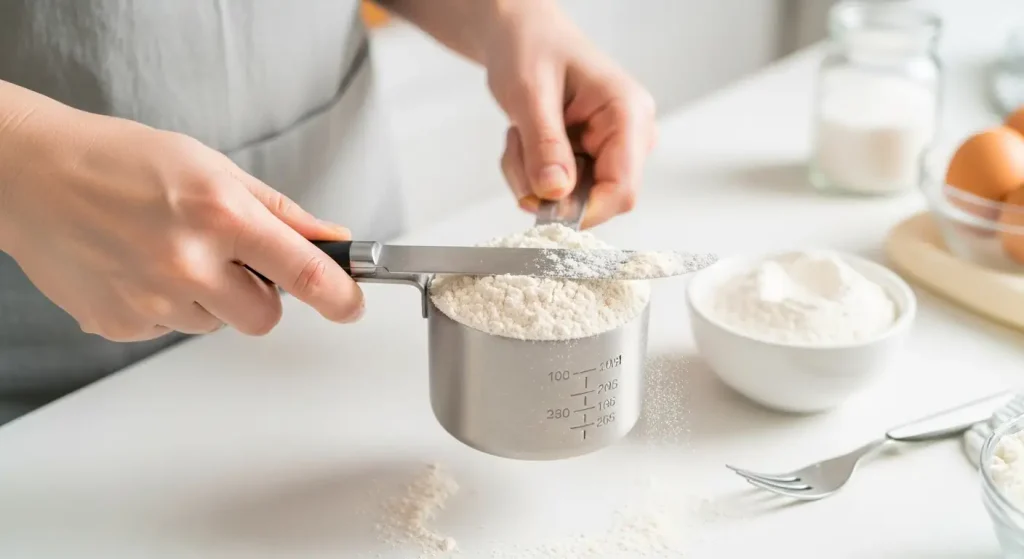
When measuring dry ingredients like flour or sugar using spoons or cups, it is essential to level off the ingredient with a knife.
- Dip your spoon or cup into the ingredient.
- Hold a butter knife (or other dull item) flat against the top of the spoon.
- Drag the knife across the top to scrape off the excess.
Anything above the spoon’s brim is considered excess, and scraping it off ensures a more accurate volumetric measurement. Also, remember to fluff your flour with a fork before measuring, as compaction can significantly affect the weight.
Handful Approximations
If you lack even basic measuring tools, your own hand can provide a highly rough approximation of weight, though this varies based on hand size.
Method 2: The Power of Conversion Charts and Density
A robust way to calculate grams without a scale is by using conversions. Since a “gram” measures mass and a “cup” or “teaspoon” measures volume, they are not directly interchangeable with a single formula.
However, by knowing the density of common ingredients, you can convert volume measurements (like cups) into mass (grams).
Stats…
The use of cups and glasses as fixed, standard measuring tools in recipes started in the late 19th century, particularly with the release of Fannie Farmer’s Boston Cooking-School Cook Book in the United States in 1896. Midland Daily News
Converting Standard Units to Grams
Keep a conversion calculator or chart readily available when a scale isn’t an option.
Kilograms to Grams
A kilogram (kg) is equal to 1,000 grams (g). To convert kilograms to grams, simply multiply the amount by 1,000 (e.g., 11.5 kg is 11,500 g).
Ounces to Grams
If you are dealing with the imperial measurement system (ounces or pounds), multiply the amount of ounces by 28.35 to convert to grams.
Volume-to-Mass Conversions (The Density Factor)
The key to using volume for mass approximation lies in the relationship between volume and weight, often using water as a baseline. One milliliter (ml) of water is equal to 1 gram (g).
You can use this fact to roughly estimate the weight of other liquids or by comparing the volume of water needed to achieve a target weight.

For dry goods, you must rely on density averages:
If you need to eyeball 200g of flour, and the density of flour is roughly 0.53 g/ml, you would calculate 200g / 0.53 g/ml ≈ 380 ml. You can then measure 380 ml using a measuring cup to achieve a rough weight.
Using Containers as Standard References
Common kitchen containers can become temporary measuring tools once their standard capacities are known:
| Ingredient | Measurement (Coffee Cup) (approx.) | Measurement (Water Glass) (approx.) |
| Liquids/ Water | 60 ml | 180 ml |
| Oil | 50 ml | (Not specified in glass chart) |
| Sugar/Salt | 60 g | 180 g |
| Rice | 60 g | 180 g |
| Flour | 35 g | 130 g |
| Butter | 100 g | 100 g |
Key Ingredient Conversions
Since a cup of one ingredient rarely weighs the same as a cup of another, it is helpful to memorize or write down a few common conversions:
For extremely small quantities, some general teaspoon conversions are available:
Method 3: Building a DIY Balance Scale
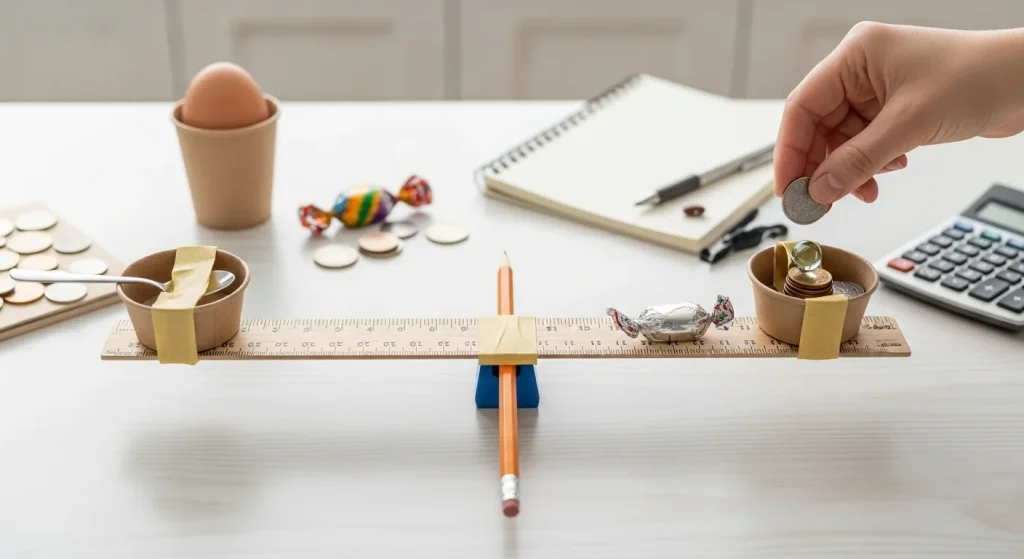
If you need to weigh a small item for a non-culinary purpose, or if you require an improvised but comparative measurement, you can construct a makeshift scale using the principle of the lever. This DIY scale provides surprisingly accurate measurements in grams, provided you use weights of a known standard.
Tools for the Homemade Scale
You will need common household items:
Constructing and Calibrating the Scale
- Set the Fulcrum: Place the pencil on a flat surface.
- Balance the Beam: Balance the ruler perpendicularly on top of the pencil. For a standard 12-inch ruler, the 6-inch mark (the center of mass) should help you find the initial balance point.
- Secure the Balance: You can use a piece of tape where the ruler rests on the pencil to prevent slipping. The ruler should maintain its balance without touching the surface.
- Create Dishes (Optional): Tape or glue small paper cups or cardboard squares to both ends of the ruler to serve as bases for your weights and objects. Ensure these dishes are equidistant from the center of mass so the ruler remains balanced.
Using Standardized Weights (U.S. Coins)
The accuracy of this scale relies on using objects with a known, standardized weight. United States coins are minted to an accuracy of a thousandth of a gram (though wear and grime might affect older coins, so consider your accuracy to be about 1/10th of a gram).
| U.S. Coin | Standard Weight (Grams) |
| Penny | 2.500 g |
| Nickel | 5.000 g |
| Dime | 2.268 g |
| Quarter | 5.670 g |
Measuring the Unknown Object
- Place the object you want to weigh on one end of the balanced scale.
- Place the coins, one by one, on the other end.
- When the scale balances (the ruler is horizontal and no longer touches the surface), add up the known weights of the coins to find the mass of the object.
For example, if an object requires two dimes and one penny to achieve balance, the total mass is: (2 x 2.268 g) + 2.500 g = 7.036 grams (or approximately 7.1 grams, accounting for potential inaccuracy).
Leveraging the Lever Ratio
For heavier items, you can use the lever principle by shifting the fulcrum if you have a known weight (like 1 kg of water).
- Place the known weight (Water) on one end and the unknown item (Item) on the other.
- Find the balance point (the fulcrum or pencil).
- Measure the distance from the water to the fulcrum (a) and the distance from the item to the fulcrum (b).
- The item’s weight is approximately (b/a) multiplied by the known weight. (E.g., if a known 1 kg weight is 30 cm from the fulcrum, and the unknown item is 150 cm from the fulcrum, the item weighs (30/150) * 1 kg = 0.2 kg, or 200 grams).
When to Stop Guessing?
While these methods are excellent substitutes in a bind, it’s crucial to acknowledge their limitations.
The only way to measure grams precisely is with a scale because measuring grams without a scale is difficult even hectic sometimes. For baking, accuracy is non-negotiable. As J. Kenji López-Alt, a Chef and Food Science Writer said, a digital kitchen scale measuring by weight is essential for baking recipes that require precision.
The Argument for Investment
For beginners or those pursuing consistent results, especially in baking, a kitchen scale is often considered an essential investment. Accurate, cheap, and convenient kitchen scales are readily available, often for around $10 to $20 USD, and they last for years.
A scale makes processes faster and reduces washing up compared to using multiple measuring cups. Furthermore, a scale eliminates the variability inherent in measuring volume—like whether flour was packed tightly or sifted, which drastically changes the mass of a “cup”.
The Tare Function: When you do acquire a scale, use the tare function (the reset button). This feature allows you to weigh an empty container (like a mixing bowl) first, zero out the scale, and then add your ingredient until you reach the target gram measurement, ensuring the container’s mass isn’t counted in the final result.
Conclusion
To make your scale-free measurements even more useful, remember that ingredients in the real world are rarely uniform. When relying on conversion charts (Method 2), always account for the physical state of your ingredients:
Packing: If you are measuring flour or brown sugar by the scoop-and-level method, assume the conversion chart accounts for the average density of uncompacted, leveled material. If you accidentally pack the flour down, you are adding significantly more mass than the conversion suggests.
Type of Ingredient: Density is highly variable. For instance, kosher salt has a much lower density (meaning less weight per volume) than regular table salt. A teaspoon of one might be 5g, while a teaspoon of the other might only be 3g. Always use the most specific conversion chart you can find for the exact ingredient you are using.
Think of measuring grams without a scale like navigating with a compass and map instead of a GPS system. The scale (GPS) gives you exact coordinates instantly.
Conversions and DIY balances (compass and map) require more effort, knowledge of reference points (known coin weights, water density), and careful calculation, and they will only provide a reliable approximation. You can get to your destination, but you must be prepared for minor deviations!
Most Asked Questions
Can I use my phone as a gram scale?
Yes, you can use your phone as a rough gram scale with special “digital scale” apps, but it’s not a truly accurate or reliable replacement for a real scale.
These apps rely on your phone’s sensors or screen pressure and are generally only suitable for estimating the weight of very small, light items, often with limited precision and inconsistent calibration.
Many “scale” apps are just simulators or gimmicks, and some experts note that current smartphones don’t have the right built-in sensors for precise weighing, so results can be misleading and you risk damaging your screen if you place heavy or hard objects on it.
For accurate measurements, specially for cooking, jewelry, or science, you should use a dedicated digital gram scale and, if you like app integration, pair it with a Bluetooth “smart” scale that sends reliable readings to your phone.
How to measure ingredients without a scale?
When you’re without a scale, reach for your standard kitchenware to measure ingredients. A tablespoon holds roughly 15g of flour or sugar, while a teaspoon holds about 5g. For liquids, a standard water glass is usually 250ml (1 cup). You can also use “handy” visual cues: a handful of flour is roughly 30g, and a tennis-ball-sized portion equals about a half-cup.
The below video is helpful because it demonstrates how to use common mugs and spoons to get reliable measurements for everyday cooking when you don’t have a scale or measuring jug. Youtube Video >> Measuring ingredients with no scale or jug
What can I use to weigh a gram?
You can weigh about a gram using common household items and simple conversions.
For example, a standard metal paperclip weighs roughly 1 gram, U.S. coins like a penny (2.5 g) or dime (2.27 g) can be used as reference fractions of a gram, and in the kitchen you can approximate 1 gram of water as 1 milliliter in a measuring spoon or cup.
For small amounts of ingredients, measuring spoons are also handy: 1 teaspoon of water is about 5 grams, so one-fifth of a level teaspoon is close to 1 gram, though this becomes less accurate with dry ingredients because their density varies.
While these tricks are fine for rough estimates in cooking or crafts, a digital gram scale is still the best option whenever you need precise, reliable measurements.
What is exactly 1 gram?
Exactly 1 gram is a metric unit of mass equal to one-thousandth of a kilogram (0.001 kg), or about 0.035 ounces, and by definition it’s the mass of 1 cubic centimeter (1 milliliter) of pure water at standard temperature and pressure.
In everyday terms, 1 gram is roughly the weight of a standard paperclip or a U.S. dollar bill, which are commonly used as practical references when you don’t have a scale handy.