How Much Does a Gallon of Water Weigh? US vs Imperial Gallon
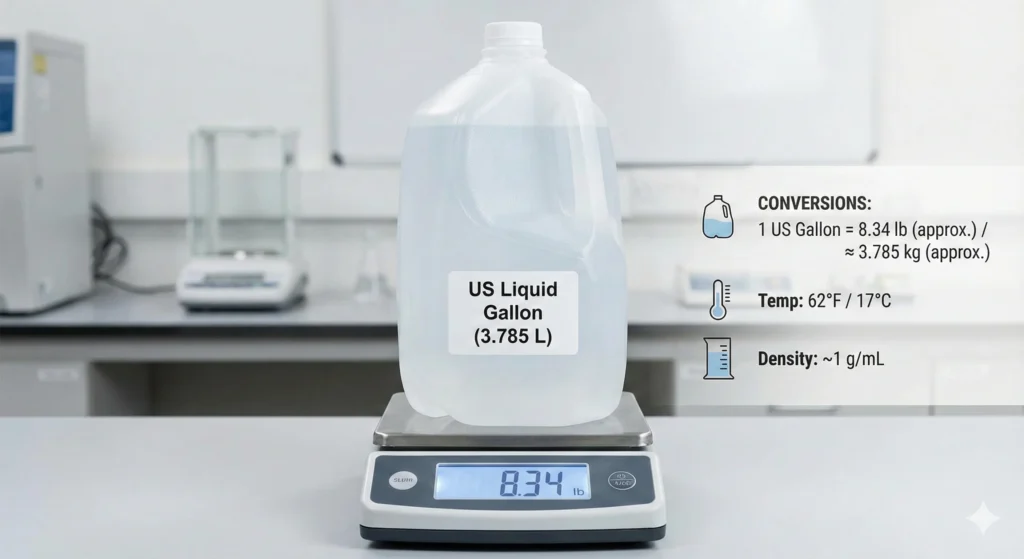
One US gallon of fresh water weighs approximately 8.34 pounds (lbs) at room temperature (62 Fahrenheit).
If you are planning a DIY project, setting up a new aquarium, or calculating the towing weight of your RV, knowing the weight of water isn’t just “good to know”—it’s a matter of safety.
=
Use the water weight tool to calculate the exact weight of your water container. Input your gallons below to get the total weight in pounds.
However, because water density changes based on temperature and what’s dissolved in it (like salt), that number can fluctuate. Here is a quick reference for the most common sizes:
|
Volume |
Weight (lbs) |
Weight (kg) |
|---|---|---|
|
1 Gallon |
8.34 lbs |
3.78 kg |
|
5 Gallons |
41.7 lbs |
18.9 kg |
|
10 Gallons |
83.4 lbs |
37.8 kg |
|
20 Gallons |
166.8 lbs |
75.6 kg |
|
30 Gallons |
250.2 lbs |
113.5 kg |
|
50 Gallons |
417.0 lbs |
189 kg |
|
75 Gallons |
625.5 lbs |
283.7 kg |
|
100 Gallons |
834 lbs |
378 kg |
|
250 Gallons |
2085 lbs |
946 kg |
|
500 Gallons |
4170 lbs |
1890 kg |
|
1000 Gallons |
8340 lbs |
3780 kg |
For more comprehensive water gallons data, check the Water Weight Gallon Chart.
Why Water Weight Fluctuates: The Density Factors
About 8.34 pounds is the standard water weigh and is a dynamic substance. Its weight is determined by the formula:
Why Temperature Creates Small Variations in Water Weight
Water weight is always referenced against a standard measurement condition, not because water is static, but because it changes subtly with temperature.
The commonly cited per gallon weight assumes a temperature where water reaches its maximum density, which occurs just above freezing.
At this point, water molecules occupy space most efficiently. As temperatures move away from this reference (either colder or warmer), the internal structure shifts slightly.
Heating causes molecules to vibrate and separate, while cooling below the peak density point leads to structural expansion associated with ice formation. Both effects reduce how much mass fits into a fixed gallon.
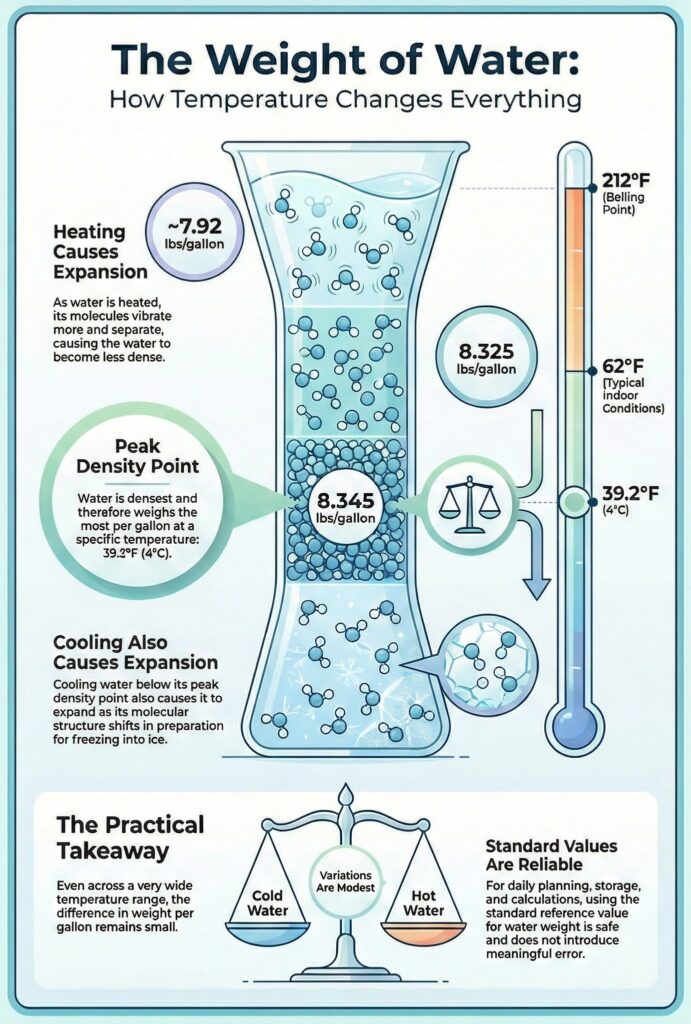
These changes are measurable but modest:
The key takeaway is not the exact variation, but the scale of it. Even across a wide temperature range, the difference remains small enough that standard planning, storage, and daily calculations safely rely on the reference value without meaningful error.
How Gravity, Air Pressure, and Elevation Influence Water Weight
Water weight is not an isolated property, and is measured within an environment. The force that makes water feel heavy is gravity, and that force varies depending on where the measurement takes place.
On Earth, gravity pulls objects toward the planet’s center with nearly uniform strength, which is why water weight is treated as a constant for everyday use.
If gravity were stronger, the same mass of water would register as heavier. If gravity were weaker, it would register as lighter. This is why weight is technically different from mass: mass remains fixed, while weight reflects how strongly gravity acts on that mass.
Standard water weight values assume Earth’s surface gravity at sea level, which provides a consistent reference point.
Air pressure introduces a secondary effect. At lower elevations, the atmosphere presses more strongly on objects because there is more air above them. As elevation increases, atmospheric pressure drops. This slightly reduces the force acting on objects, including water, causing a marginal decrease in measured weight at higher altitudes.
In practical terms, these differences are extremely small. A gallon of water measured on a mountain weighs almost the same as it does at sea level, and the variation is far below what matters for household use, travel planning, or storage.
These factors are mainly relevant in scientific measurements or precision engineering, where environmental conditions must be tightly controlled.
Freshwater VS Salt Water
If you are a reef tank enthusiast or a boat owner, you need to account for salt. Because salt adds mass without significantly increasing volume, saltwater is heavier, weighing approximately 8.55 lbs per gallon.
Imagine a 300-pound reef tank challenge: at 8.55 lbs per gallon of saltwater, you’d need roughly 35 gallons to hit that mark—perfect for serious coral enthusiasts or boat owners managing live loads.
Quick Calculation
300 lbs ÷ 8.55 lbs/gallon = 35.09 gallons
Want to see everyday things that weigh exactly 300 pounds? Check out Things That Weigh 300 Pounds.
How much does a gallon of saltwater weigh?
One gallon of saltwater weighs about 8.55 pounds (3.88 kg), which is slightly heavier than fresh water. Fresh water weighs 3.78 kilogram per gallon, while saltwater weighs more due to dissolved salts increasing density.
Practical Example
In a saltwater aquarium system, a 50-gallon tank holds about 427.5 pounds of water, which is over 10 pounds heavier than fresh water at the same volume.
Why Saltwater Weighs More
- Dissolved minerals increase density
- Ocean-grade salinity raises total mass
- Higher density leads to higher load on tanks and stands
How much does 1 liter of water weigh?
One liter of fresh water at standard room temperature (21°C / 70°F) weighs approximately 1 Kilogram (35.2 ounces or 2.2 pounds). Moreover, the density of water is around 1g/ml (0.998g/ml) at room temperature.
| Condition | Temperature | Density (kg/m³) | Weight of 1 Litre (kg) |
|---|---|---|---|
| Freezing Point | 0 °C (Liquid) | 999.82 | 0.9998 |
| Maximum Density | 4 °C | 1000.00 | 1.0000 |
| Cool Room | 15 °C | 999.19 | 0.9992 |
| Standard Lab | 20 °C | 998.29 | 0.9983 |
| Warm Room | 25 °C | 997.13 | 0.9971 |
| Hot Water | 50 °C | 988.02 | 0.9880 |
| Boiling | 100 °C | 958.05 | 0.9581 |
How much does 500ml of water weigh?
At a comfortable room temperature of 70°F (21°C), a 500ml volume of water weighs approximately 1.1 lbs (17.6 ounces). Because water’s density at this temperature is nearly perfect at 0.998 g/ml, it translates almost exactly to a mass of 500 grams. This convenient 1:1 ratio makes it easy for DIYers and cooks to estimate weight without needing a scale.
Quick Conversion Breakout
| Volume | Metric Weight | US Weight | Density Factor |
| 500ml (about 16.9 fl oz) | 500 grams approx | ~1.1 lbs | 0.998 g/ml |
How much does a 16.9 oz bottle of water weigh?
At a standard room temperature of 70°F (21°C), a common 16.9 fl oz bottle of water has a total weight of approximately 1.12 lbs (17.95 ounces).
To get an accurate measurement, you have to look at two separate parts: the liquid and the packaging.
The Breakdown: Water vs. Bottle
- The Liquid: The 16.9 fluid ounces of water itself weighs about 1.1 lbs (17.6 ounces).
- The Container: A typical plastic bottle adds roughly 0.35 ounces (0.022 lbs) to the scale.
- The Total: When combined, you are carrying or shipping approximately 1.12 lbs.
A Note on Measurement Units
It is important to note that these figures are based on the US fluid ounce (29.57 ml). If you are using UK Imperial fluid ounces (28.41 ml), the volume and resulting weight will be slightly lower. This distinction is vital for accurate weight distribution in shipping or travel planning.
US Gallon VS Imperial Gallon
One of the biggest mistakes DIYers make is following a guide from the UK or Canada without checking the units.
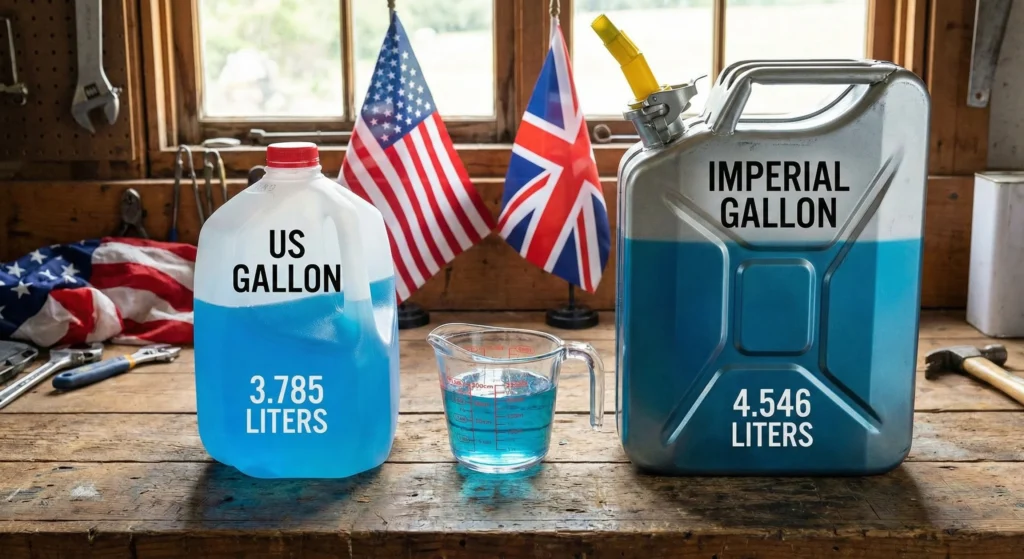
- US Liquid Gallon: 8.34 lbs (3.78 Liters)
- Imperial (UK) Gallon: 10.02 lbs (4.54 Liters)
If you are building a stand for a “10-gallon” tank based on a British manual, your calculations will be off by nearly 17 pounds. Always ensure your source is using US Customary units.
How much does an imperial gallon of water weigh?
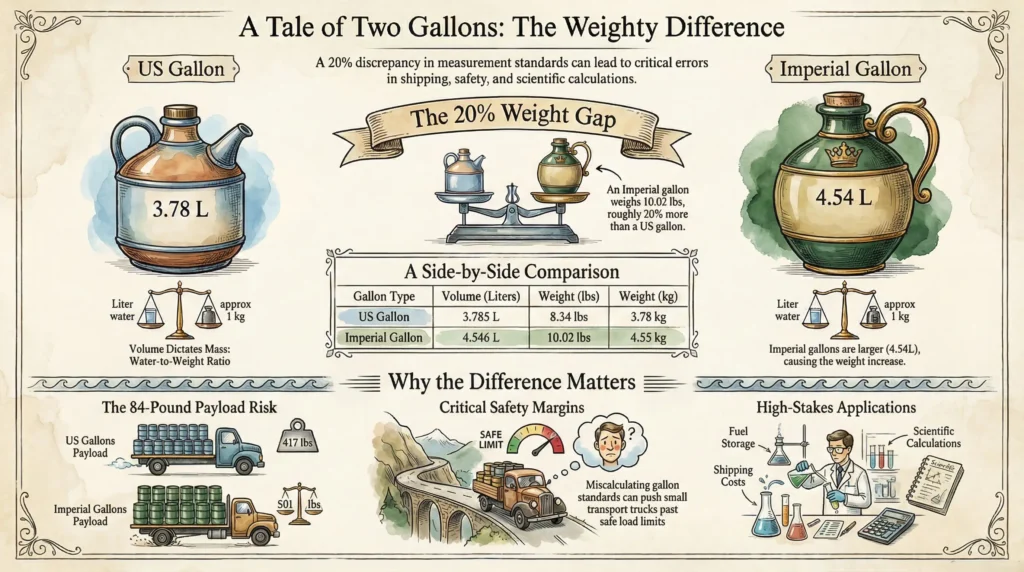
One imperial gallon of water weighs about 10.02 pounds (4.54 kilograms) at room temperature. This is heavier than a US gallon because the imperial gallon is larger in volume.
An imperial gallon equals 4.54 liters, while a US gallon equals 3.78 liters. Since one liter of water weighs almost exactly 1 kilogram, the total weight increases with volume. That is why an imperial gallon weighs roughly 20 percent more than a US gallon. (Math.net)
You can quickly calculate the exact weight for any volume using our Weight Calculator to save time and avoid errors.
Imperial Gallon vs US Gallon Weight Comparison
| Gallon type | Volume (liters) | Weight (lbs) | Weight (kg) |
|---|---|---|---|
| US gallon | 3.785 L | 8.34 lbs | 3.78 kg |
| Imperial gallon | 4.546 L | 10.02 lbs | 4.55 kg |
Why the difference in US and Imperial Gallon matters?
This difference becomes critical in shipping, cooking, fuel storage, and scientific calculations. Using the wrong gallon standard can create 20 percent measurement errors, which directly affects load limits, cost estimates, and safety margins.
For example, transporting 50 imperial gallons of water adds about 501 pounds, while 50 US gallons weigh only about 417 pounds. That 84-pound gap can push small trucks past safe load limits.
How much does 5 gallons of water weigh?
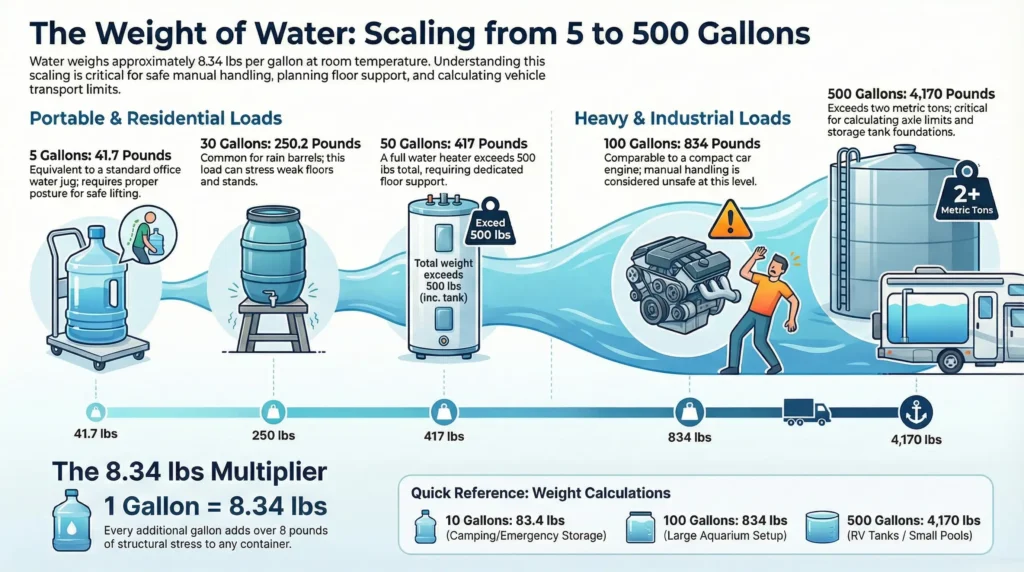
Five gallons of water weigh about 41.7 pounds (18.9 kg) at room temperature. Since one US gallon of water weighs 8.34 pounds, multiplying by five gives a quick and reliable estimate.
Example
A standard 5-gallon water jug used in offices and gyms weighs over 40 pounds when full. This explains why lifting these bottles safely requires proper grip and posture.
Why this matters
Knowing this weight helps you:
- Estimate lifting effort
- Plan safe carrying loads
- Avoid back strain
- Calculate transport weight accurately
How heavy is 10 gallons of water?
Ten gallons of water weigh about 83.4 pounds (37.8 kg). This amount equals the combined weight of two full 5-gallon jugs.
Weight Calculation
10 gallons × 8.34 lbs = 83.4 pounds
Example
A 10-gallon water container used for camping or emergency storage weighs over 80 pounds when full. This can exceed safe lifting limits for many people and small carts.
How heavy is 30 gallons of water?
Thirty gallons of water weigh about 250.2 pounds (113.5 kg). This is the weight of three fully loaded 10-gallon containers.
Quick Calculation
30 gallons × 8.34 lbs = 250.2 pounds
Example
A 30-gallon rain barrel or aquarium tank holds over 250 pounds of water, excluding container weight. When filled, this load can stress weak floors, stands, and supports.
How much does 50 gallons of water weigh?
Fifty gallons of water weigh about 417 pounds (189 kilograms) at room temperature. This amount equals the weight of five fully filled 10-gallon containers.
Practical Example
A 50-gallon water heater tank holds over 400 pounds of water alone. When combined with the tank weight, total load can exceed 500 pounds, which explains why strong floor support matters.
Use Cases
How much does 100 gallons of water weigh?
One hundred gallons of water weigh about 834 pounds (378 kilograms).This is close to the weight of a small compact car engine.
Quick Calculation
100 gallons × 8.34 lbs = 834 lbs
Real World Example
A 100-gallon aquarium contains over 830 pounds of water, not counting glass, gravel, and equipment. This explains why aquarium stands and floor load ratings are critical.
Planning Insight
At this weight level, manual handling becomes unsafe. Always use mechanical lifting or pump transfer systems.
How much does 250 gallons of water weigh?
250 gallons of water weigh about 2085 pounds (946 kilograms) when measured in US gallons at room temperature.
Quick Calculation
250 gallons × 8.34 lbs = 2085 Pounds
Real World Applictions
A 250 gallon water storage tank used for irrigation or rainwater collection holds more than one ton of water. When you include the tank itself, the total load often exceeds 2200 pounds. This level of weight requires solid ground support or a reinforced platform.
How much does 500 gallons of water weigh?
Five hundred gallons of water weigh about 4170 pounds (1,890 kilograms). This equals more than two metric tons.
Quick Calculation
500 gallons × 8.34 lbs = 4170 Pounds
Real World Applictions
A 500-gallon water storage tank or small pool fill adds over 4,000 pounds of load. This affects:
Why Accuracy Matters
At this scale, even small calculation errors can exceed axle limits and safety thresholds.
Real-World Applications: Why This Number Matters
Aquariums & Fish Tanks
A “10 gallon” tank doesn’t just weigh 83 lbs. When you add the weight of the glass, the substrate (gravel), and the lid, a small 10 gallon setup can easily exceed 100 to 120 lbs. Always ensure your furniture is rated for “static loads” before filling a tank.
RVs, Boats, and Camping
For RV enthusiasts, water management is weight management. If your RV has a 40 gallon freshwater tank, filling it to the brim adds 333.6 pounds to your vehicle. This directly impacts your fuel economy, braking distance, and your Gross Vehicle Weight Rating (GVWR).
Backpacking & Survival
In the survivalist community, we say “ounces equal pounds, and pounds equal pain.” Carrying just two gallons of emergency water adds over 16 lbs to your pack—which can be nearly 30-40% of a standard hiker’s load.
How Other Liquids Compare
Is a gallon of water always the “gold standard” for weight? Not quite.
- Milk: A gallon of milk weighs about 8.6 lbs because it contains fats and proteins that are denser than water.
- Gasoline: Much lighter than water at about 6.1 lbs. This is why gasoline floats on top of water during a spill.
- Honey: One of the heaviest kitchen liquids, a gallon of honey can weigh a staggering 12 lbs.
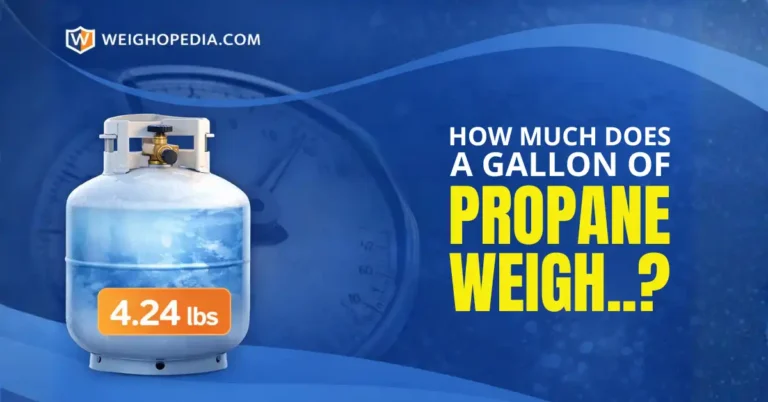
- Propane: One gallon of propane weight is about half of the water gallon i.e 4.24 lbs.
Water Density Chart
To truly understand how water weight changes, we have to look at its density. Water is a unique substance because it reaches its maximum density (and thus its maximum weight) at a very specific cold temperature, then becomes lighter as it gets hotter.
The data below is adapted from the U.S. Bureau of Reclamation’s Ground Water Manual, providing a precise look at how temperature shifts the density of fresh water.
Water Density vs. Temperature Chart
As the temperature rises, water molecules move faster and spread apart, causing the liquid to expand and its weight to drop.
|
Water Temp (°F / °C) |
Density (g/ml) |
Impact on Weight |
|---|---|---|
|
32°F / 0°C |
0.99987 |
Near maximum density |
|
39.2°F / 4.0°C |
1.00000 |
Peak Density (Heaviest) |
|
40°F / 4.4°C |
0.99999 |
Standard cold water |
|
50°F / 10°C |
0.99975 |
Chilled tap water |
|
60°F / 15.6°C |
0.99907 |
Cool tap water |
|
70°F / 21.0°C |
0.99802 |
Standard Room Temp |
|
80°F / 26.7°C |
0.99669 |
Warm water |
|
90°F / 32.2°C |
0.99510 |
Very warm/Bath temp |
|
100°F / 37.8°C |
0.99318 |
Hot water |
|
120°F / 48.9°C |
0.98870 |
Typical hot water heater setting |
|
140°F / 60.0°C |
0.98338 |
Industrial hot water |
|
160°F / 71.1°C |
0.97729 |
Very hot / Pre-boiling |
|
180°F / 82.2°C |
0.97056 |
Steaming hot |
|
200°F / 93.3°C |
0.96333 |
Near boiling point |
|
212°F / 100°C |
0.95865 |
Boiling point (Lightest) |
Frequently Asked Questions (FAQs)
How much does water weigh per gallon?
A US gallon (commonly considered as a “gallon”) is definied as 3.785411 litres (exactly 231 cubic inchs) that makes it 8.3454 pounds of water weight per gallon at 39.169°F, which makes it 832.6742 milliliters (83.2674%) of an imperial gallon. (Wikipedia)
A gallon is made of smaller parts. There are 4 quarts in 1 gallon. Each quart has 2 pints. Each pint has 16 fluid ounces. So, 1 fluid ounce is 1/128 of a gallon.
How much does half a gallon of water weigh?
Half a US gallon of water weighs 4.17 pounds at 39.169°F. A half gallon equals 2 quarts or 4 pints, but the weight can vary slightly as the water temperature rises or falls.
Does water weigh more when it’s cold?
Yes, slightly. Colder water packs molecules closer together, allowing marginally more mass to fit into the same volume. The difference is measurable in controlled conditions but insignificant for everyday use.
Does boiling water weigh less?
Boiling causes some water molecules to escape as vapor, which reduces total mass if evaporation occurs. However, simply heating water (without loss) does not meaningfully change the weight of a measured gallon.
Is a gallon of water heavier than a gallon of milk?
A gallon of milk is heavier because it contains dissolved fats, proteins, and sugars that add mass within the same volume. Equal container size does not mean equal weight.
Does altitude affect the weight of water?
Altitude does not change the mass of water, but it slightly alters how weight is measured due to reduced gravitational force. For practical purposes, this difference is negligible outside of scientific calculations.
Final Takeaway
The weight of a gallon of water is often treated as a simple fact, but the full picture is shaped by definitions, conditions, and context. Volume alone does not determine weight i.e how that volume is measured, what the water contains, and the environment in which it exists all play a role.
For everyday use, standardized assumptions make water weight reliable and easy to work with. These standards allow people to plan, store, transport, and calculate without needing to account for minor physical variations that rarely affect real-world outcomes.
When conditions fall outside the norm—such as extreme temperatures, dissolved materials, or precision measurements and those assumptions can be adjusted accordingly.
Understanding where water weight comes from, rather than memorizing a single figure, makes the concept more useful and transferable. Whether the goal is planning hydration, managing storage, or using a calculator for larger volumes, the key is knowing when precision matters and when simplicity is sufficient.
This balance between accuracy and practicality is why water weight remains one of the most dependable reference points in everyday measurement.
For more informative article, keep visiting Weighopedia.com
|
Water Volume (Gallon) |
Weight (lbs) |
Weight (kg) |
|---|---|---|
|
1 |
8.34 |
3.78 |
|
2 |
16.68 |
7.56 |
|
3 |
25.02 |
11.34 |
|
4 |
33.36 |
15.12 |
|
5 |
41.70 |
18.90 |
|
6 |
50.04 |
22.68 |
|
7 |
58.38 |
26.46 |
|
8 |
66.72 |
30.24 |
|
9 |
75.06 |
34.02 |
|
10 |
83.40 |
37.80 |
|
11 |
91.74 |
41.58 |
|
12 |
100.08 |
45.36 |
|
13 |
108.42 |
49.14 |
|
14 |
116.76 |
52.92 |
|
15 |
125.10 |
56.70 |
|
16 |
133.44 |
60.48 |
|
17 |
141.78 |
64.26 |
|
18 |
150.12 |
68.04 |
|
19 |
158.46 |
71.82 |
|
20 |
166.80 |
75.60 |
|
25 |
208.50 |
94.50 |
|
30 |
250.20 |
113.40 |
|
35 |
291.90 |
132.30 |
|
40 |
333.60 |
151.20 |
|
45 |
375.30 |
170.10 |
|
50 |
417.00 |
189.00 |
|
55 |
458.70 |
207.90 |
|
60 |
500.40 |
226.80 |
|
65 |
542.10 |
245.70 |
|
70 |
583.80 |
264.60 |
|
75 |
625.50 |
283.50 |
|
80 |
667.20 |
302.40 |
|
85 |
708.90 |
321.30 |
|
90 |
750.60 |
340.20 |
|
95 |
792.30 |
359.10 |
|
100 |
834.00 |
378.00 |
|
110 |
917.40 |
415.80 |
|
120 |
1000.80 |
453.60 |
|
130 |
1084.20 |
491.40 |
|
140 |
1167.60 |
529.20 |
|
150 |
1251.00 |
567.00 |
|
160 |
1334.40 |
604.80 |
|
170 |
1417.80 |
642.60 |
|
180 |
1501.20 |
680.40 |
|
190 |
1584.60 |
718.20 |
|
200 |
1668.00 |
756.00 |
|
Water Volume (Gallon) |
Weight (lbs) |
Weight (kg) |
|---|---|---|
|
201 |
1676.34 |
759.78 |
|
202 |
1684.68 |
763.56 |
|
203 |
1693.02 |
767.34 |
|
204 |
1701.36 |
771.12 |
|
205 |
1709.70 |
774.90 |
|
206 |
1718.04 |
778.68 |
|
207 |
1726.38 |
782.46 |
|
208 |
1734.72 |
786.24 |
|
209 |
1743.06 |
790.02 |
|
210 |
1751.40 |
793.80 |
|
215 |
1793.10 |
812.70 |
|
220 |
1834.80 |
831.60 |
|
225 |
1876.50 |
850.50 |
|
230 |
1918.20 |
869.40 |
|
235 |
1959.90 |
888.30 |
|
240 |
2001.60 |
907.20 |
|
245 |
2043.30 |
926.10 |
|
250 |
2085.00 |
945.00 |
|
255 |
2126.70 |
963.90 |
|
260 |
2168.40 |
982.80 |
|
265 |
2210.10 |
1001.70 |
|
270 |
2251.80 |
1020.60 |
|
275 |
2293.50 |
1039.50 |
|
280 |
2335.20 |
1058.40 |
|
285 |
2376.90 |
1077.30 |
|
290 |
2418.60 |
1096.20 |
|
295 |
2460.30 |
1115.10 |
|
300 |
2502.00 |
1134.00 |
|
310 |
2585.40 |
1171.80 |
|
320 |
2668.80 |
1209.60 |
|
330 |
2752.20 |
1247.40 |
|
340 |
2835.60 |
1285.20 |
|
350 |
2919.00 |
1323.00 |
|
360 |
3002.40 |
1360.80 |
|
370 |
3085.80 |
1398.60 |
|
380 |
3169.20 |
1436.40 |
|
390 |
3252.60 |
1474.20 |
|
400 |
3336.00 |
1512.00 |
|
Water Volume (Gallon) |
Weight (lbs) |
Weight (kg) |
|---|---|---|
|
401 |
3344.34 |
1515.78 |
|
402 |
3352.68 |
1519.56 |
|
403 |
3361.02 |
1523.34 |
|
404 |
3369.36 |
1527.12 |
|
405 |
3377.70 |
1530.90 |
|
406 |
3386.04 |
1534.68 |
|
407 |
3394.38 |
1538.46 |
|
408 |
3402.72 |
1542.24 |
|
409 |
3411.06 |
1546.02 |
|
410 |
3419.40 |
1549.80 |
|
415 |
3461.10 |
1568.70 |
|
420 |
3502.80 |
1587.60 |
|
425 |
3544.50 |
1606.50 |
|
430 |
3586.20 |
1625.40 |
|
435 |
3627.90 |
1644.30 |
|
440 |
3669.60 |
1663.20 |
|
445 |
3711.30 |
1682.10 |
|
450 |
3753.00 |
1701.00 |
|
455 |
3794.70 |
1719.90 |
|
460 |
3836.40 |
1738.80 |
|
465 |
3878.10 |
1757.70 |
|
470 |
3919.80 |
1776.60 |
|
475 |
3961.50 |
1795.50 |
|
480 |
4003.20 |
1814.40 |
|
485 |
4044.90 |
1833.30 |
|
490 |
4086.60 |
1852.20 |
|
495 |
4128.30 |
1871.10 |
|
500 |
4170.00 |
1890.00 |
|
510 |
4253.40 |
1927.80 |
|
520 |
4336.80 |
1965.60 |
|
530 |
4420.20 |
2003.40 |
|
540 |
4503.60 |
2041.20 |
|
550 |
4587.00 |
2079.00 |
|
560 |
4670.40 |
2116.80 |
|
570 |
4753.80 |
2154.60 |
|
580 |
4837.20 |
2192.40 |
|
590 |
4920.60 |
2230.20 |
|
600 |
5004.00 |
2268.00 |